Completing the Masterpiece: The Definitive Guide to Men’s Shoes and Accessories
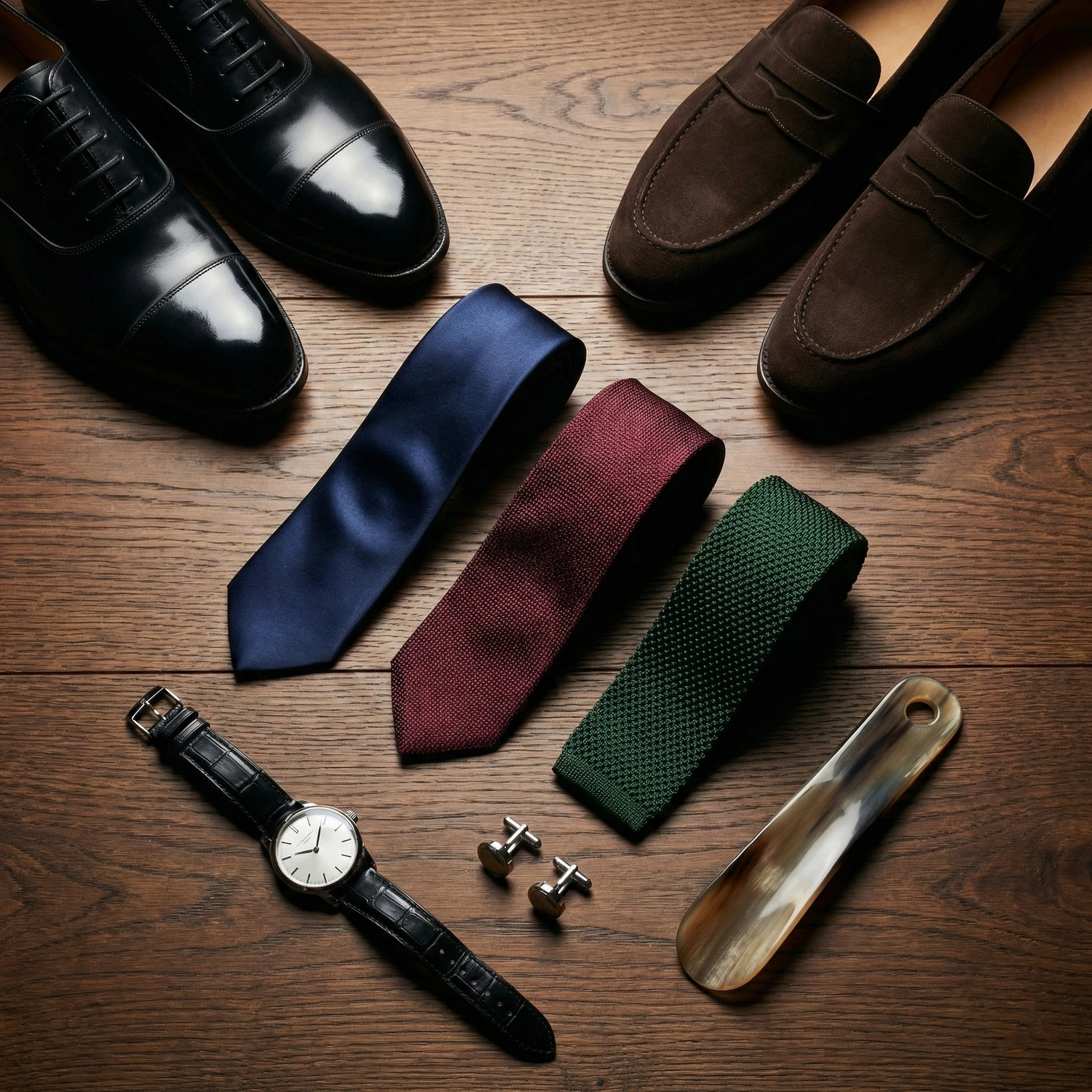
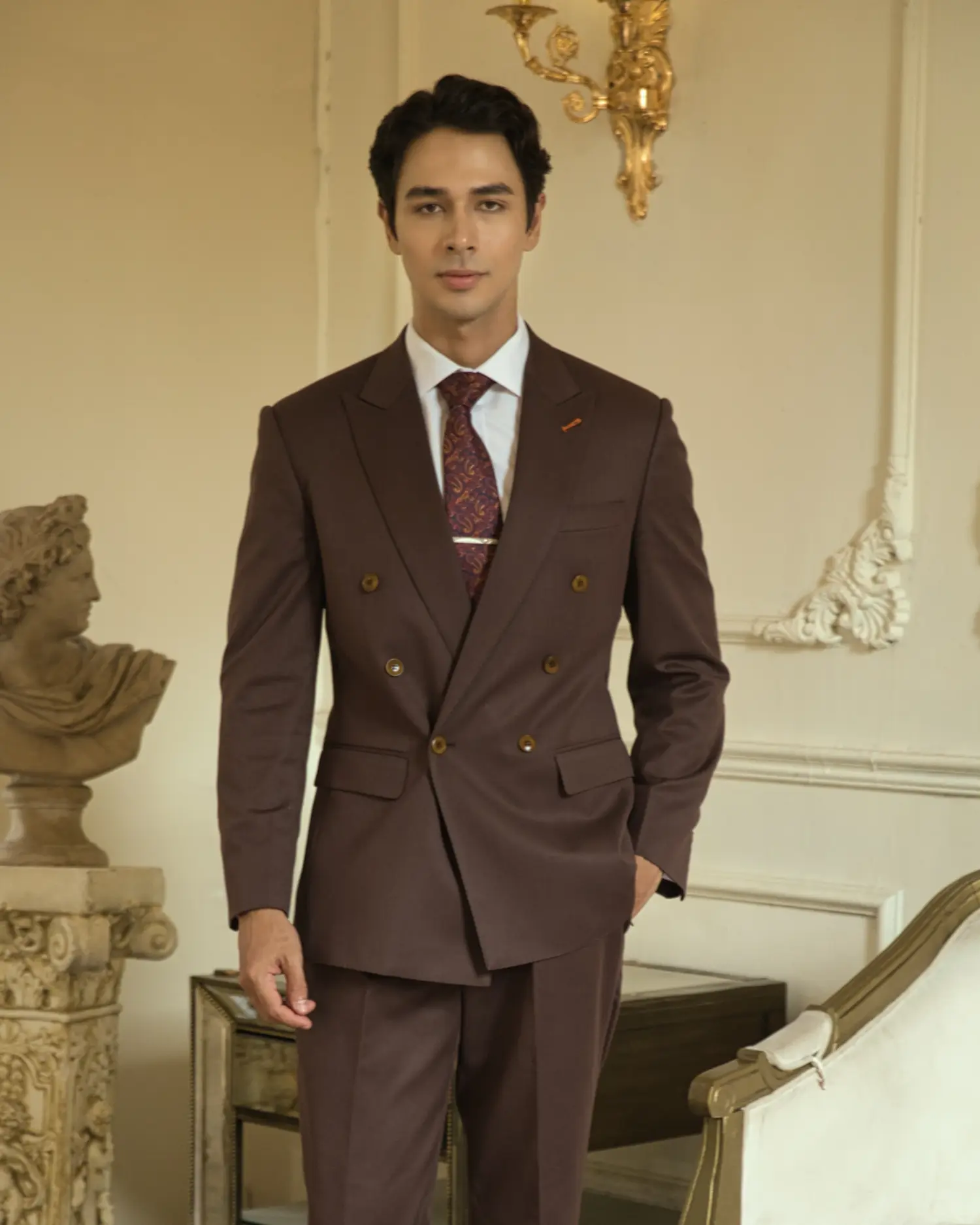
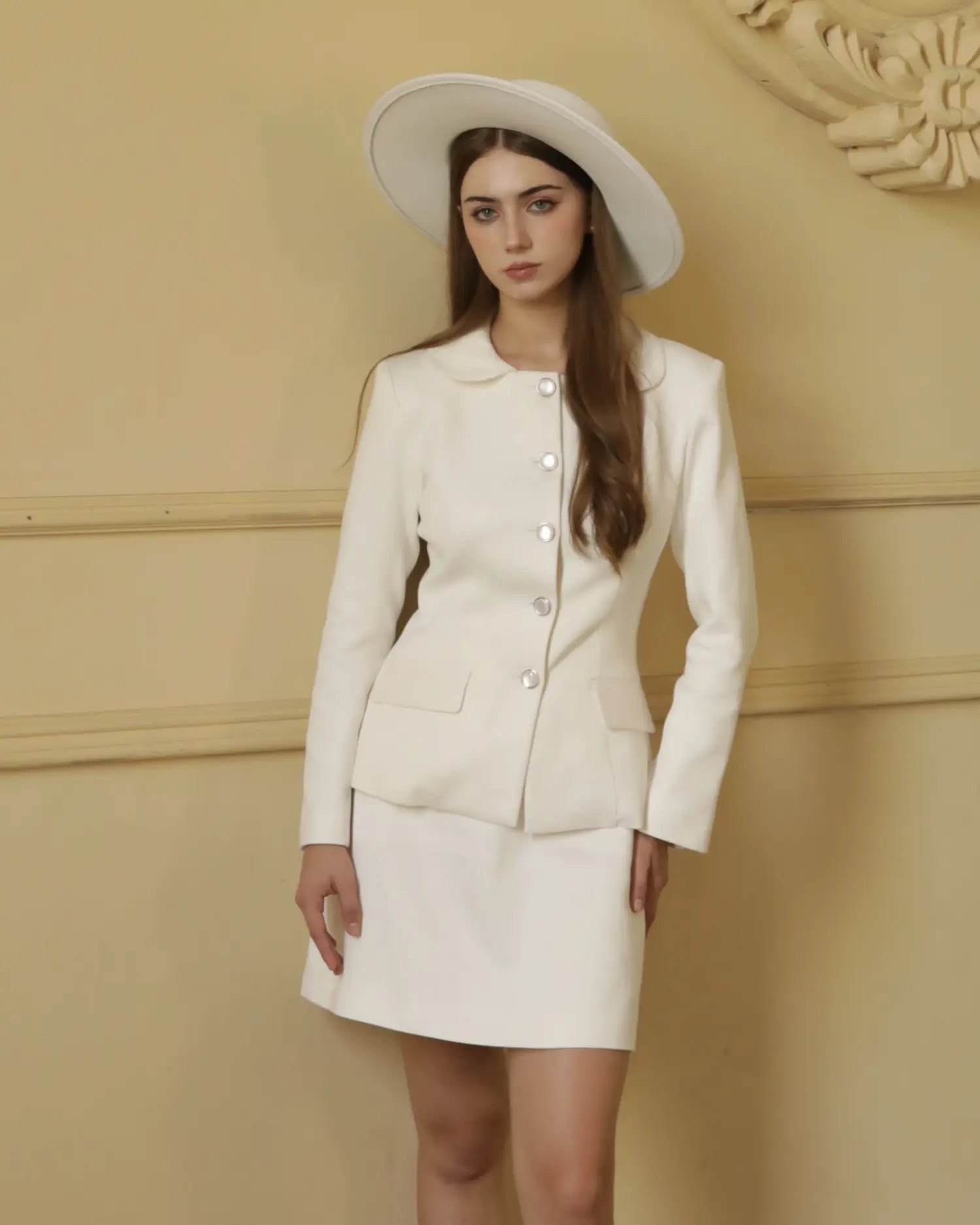
A flawlessly commissioned bespoke suit provides the structure, yet it is the Men’s Shoes and Accessories that provide the narrative. All too often, the authority of a fine garment is quietly undermined by an afterthought: be it a pair of poor-quality shoes or a jarring tie choice. Accessories are far from decorative trifles; they are powerful tools of non-verbal communication that define the wearer’s intent, transforming a rigid uniform into a sophisticated personal statement.
True style requires viewing the suit merely as a canvas. It is the calculated selection of footwear silhouettes, hosiery, and hardware that applies the defining brushstrokes. This guide serves as a manifesto on that intentionality, dismantling the nuances of construction, the geometry of neckwear, and the subtle etiquette of hosiery to help you master the finishing touches that separate the merely dressed from the truly stylish.
The Anchor: Mastering Footwear Architecture
If the suit is the house, the shoes are the foundation. No matter how impeccable your bespoke suit is, a weak foundation compromises the entire structure. Mastering footwear is not merely about choosing a brand; it is about understanding construction, silhouette, and the precise hierarchy of formality.
Construction: Durability vs. Flexibility
To the uninitiated, a generic glued shoe may look similar to a high-end pair, but the difference lies in the invisible engineering.
- The Goodyear Welt: Often cited as the gold standard for durability, particularly in the English tradition. It stitches the upper, insole, and welt together, creating a water-resistant seal and allowing for repeated resoling. It provides a substantial, authoritative silhouette.
- The Blake Stitch: However, durability is not the only metric of luxury. For those who favour a lighter, more contour-hugging profile, the Blake Stitch is the construction of choice. Often favoured by Italian masters, it offers a sleeker, more flexible alternative perfect for summer loafers or dancing shoes, where the rigid bulk of a Goodyear welt might feel cumbersome.
The Hierarchy of Formality
Understanding when to wear what is the hallmark of a sophisticated dresser. The distinction often lies in the lacing system:
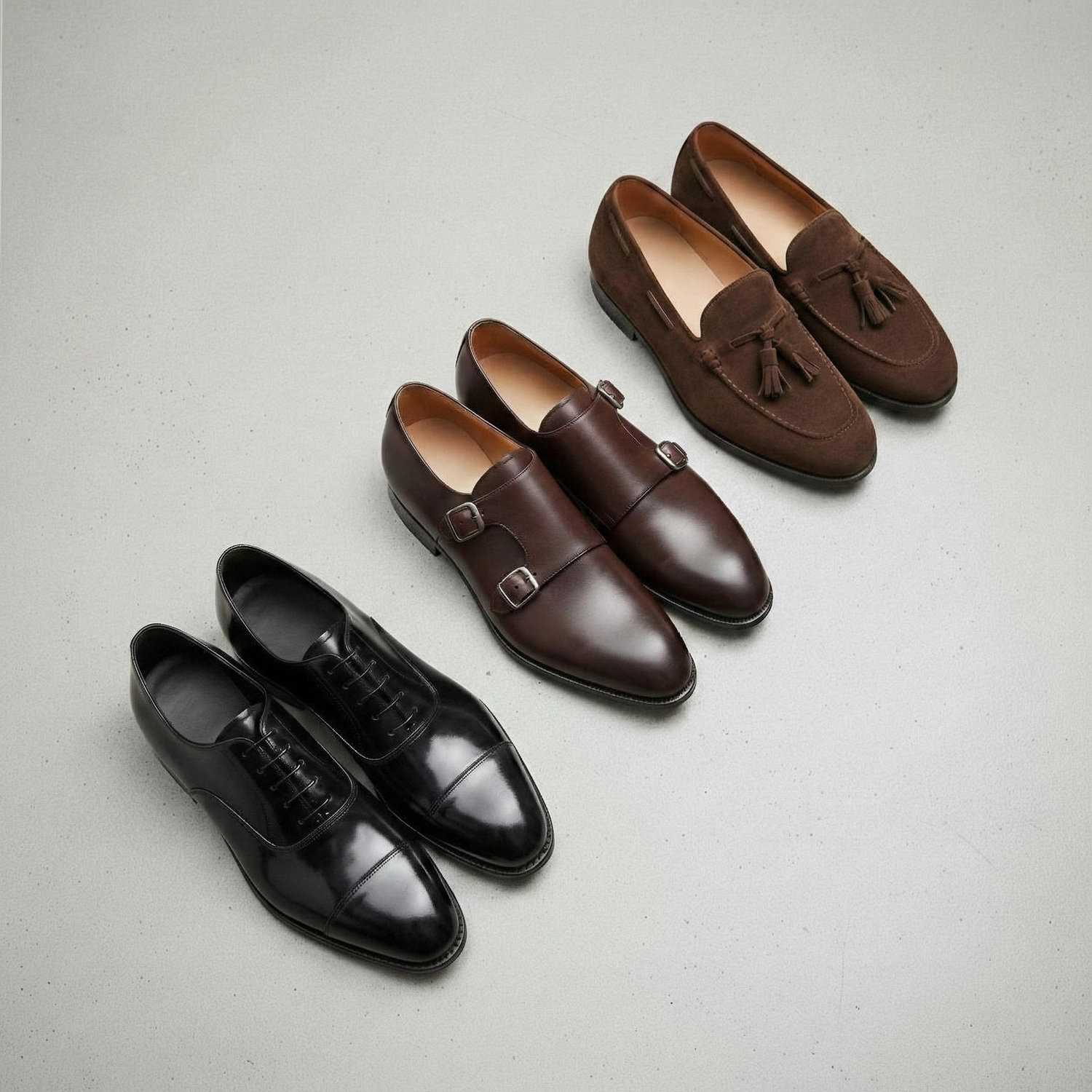
- The Oxford (Closed Lacing): The most formal option. The facing is stitched under the vamp, creating a sleek, closed “V” shape. In black calfskin, this is the non-negotiable choice for boardrooms, black-tie events, and solemn occasions.
- The Derby (Open Lacing): Here, the facing is stitched on top of the vamp, allowing for a wider opening. It is inherently less formal and more rugged: perfect for tweed jackets, travel suits, or business-casual settings.
- The Monk-Strap: Sitting comfortably between the Oxford and the Derby, the Monk-strap (single or double) replaces laces with buckles. It offers a distinct rakish appeal: a choice for the gentleman who wishes to signal a touch of creative flair or nonchalance without sacrificing elegance.
- The Loafer: The embodiment of ease. Whether a Penny or a Tassel, loafers signal a relaxed luxury. However, they demand a precise trouser length to avoid looking sloppy.
The Critical Synergy: Shoes and Trousers
This is where the concept of “fit” becomes holistic. Your choice of footwear must dictate the cut of your bespoke trousers. This relationship is defined by “The Break”: the fold created where the trouser hem meets the shoe.
- The Rule of Proportion: A sleek, low-profile shoe like a Belgian Loafer requires a trouser with a narrower hem width and little to no break (grazing the shoe). Conversely, a substantial English Brogue demands a wider hem and a slight break to maintain visual balance.
- The Mistake: Wearing wide-legged trousers with dainty loafers makes your feet disappear; wearing skinny trousers with heavy boots creates a “clown-foot” effect. A master tailor always asks, “What shoes will you wear with this?” before cutting the hem.
For a comprehensive breakdown of colour coordination and trouser break rules, read our deep-dive guide: [The Foundation of Style: A Guide to Pairing Shoes with Trousers].
The Narrative: Neckwear & Chest Depth
The “V-zone” (the area comprised of your bespoke suit lapels, shirt collar, and tie) is the command centre of your outfit. It is where the eye naturally rests during conversation. Therefore, errors here are not merely noticeable; they are distracting. Elevating this area requires moving beyond simple colour matching and mastering the deeper concepts of texture and proportion.
Texture over Shine: The Fabric of Sophistication
The most common error in menswear is the reliance on flat, shiny satin silk ties. While acceptable in strictly formal evening settings, in daylight, an excessive sheen often looks cheap and synthetic. A gentleman understands that texture conveys depth and character.
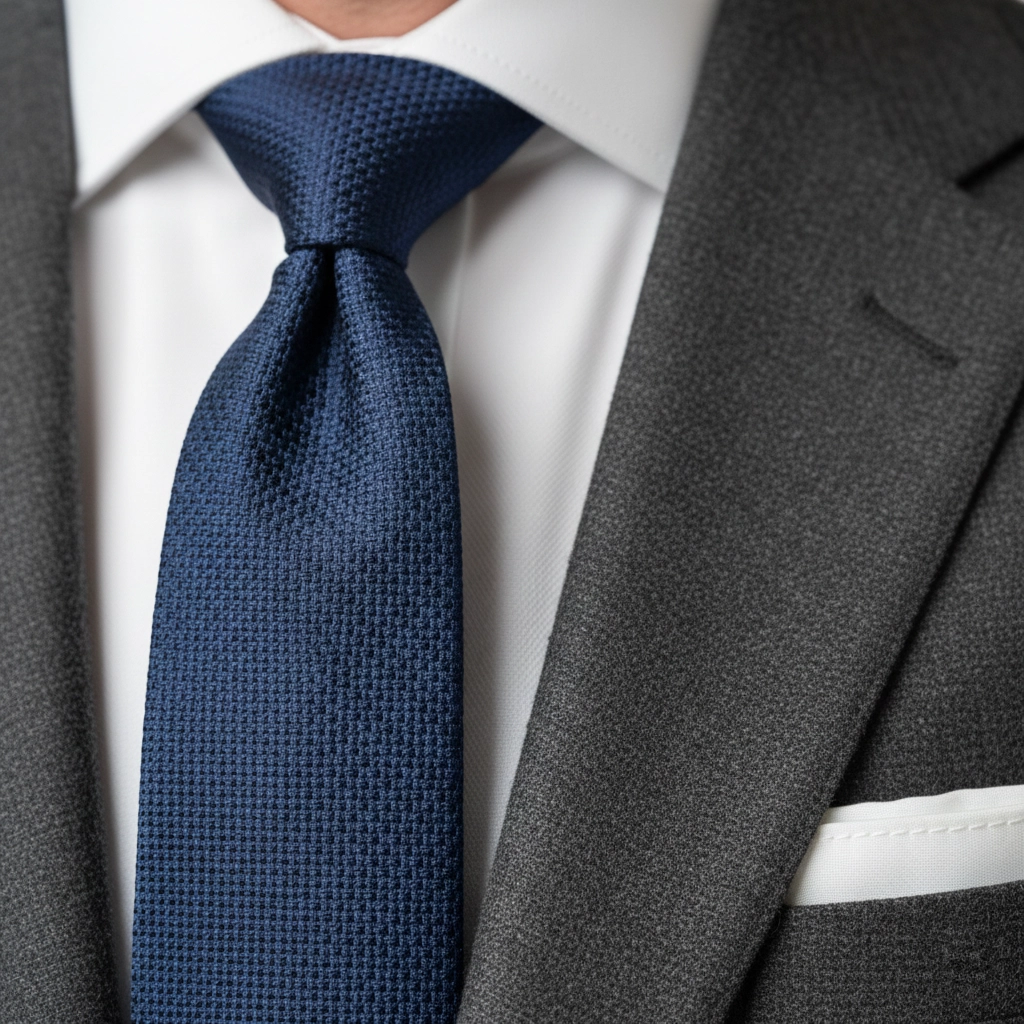
- Grenadine Silk: Often considered the king of solid ties. Woven on historic wooden looms (primarily in Como, Italy), Grenadine features a complex, open weave (Garza Grossa or Garza Fina). It offers the formality of a solid colour but with a rich, tactile surface that absorbs light rather than reflecting it. It is the ultimate bridge between business and social wear.
- Matte Finishes: For colder months or textured suits (like flannel or tweed), a shiny tie creates a visual dissonance. Instead, opt for Ancient Madder (a chalky, matte silk with deep, muted colours) or Wool/Cashmere blends. These materials harmonise with the weight of the bespoke garment rather than fighting against it.
The Geometry of Proportion
Even the most expensive tie will look awkward if it does not respect the architecture of the jacket. The Golden Rule of sartorial geometry is simple: Width begets width.
- The Mirror Effect: The width of your tie at its widest point should roughly mirror the width of your jacket’s lapel. A skinny 6cm tie worn with a generous 9cm peak lapel creates a jarring imbalance, making the wearer’s chest look vast and the tie insignificant.
- The Collar Connection: This harmony extends to the knot itself. Whether you favour the substantial symmetry of a Half-Windsor or the artful asymmetry of a classic Four-in-Hand, the knot must fill the collar space perfectly. A slender Four-in-Hand can look lost inside a wide Extreme Cutaway collar, just as a thick Windsor can look choked by a Point collar.
- The Dimple: Finally, never tighten a knot without creating a “dimple” (the small indentation just below the knot). A flat knot looks lifeless; a dimpled knot shows intent and adds a sculptural element to the silk.
The Pocket Square: A Study in Nuance
The pocket square is arguably the single most effective accessory for demonstrating flair, yet it is arguably the most misused.
- The Cardinal Sin: Never, under any circumstances, wear a pocket square that exactly matches your tie. “Matching sets” sold in department stores are the hallmark of a novice. They look forced and artificial.
- The Art of Complementing: The goal is harmony, not uniformity. Your pocket square should pick up a secondary colour from your tie or shirt, or provide a subtle contrast. For example, a navy tie with burgundy dots pairs beautifully with a solid burgundy square, or a cream silk square with navy piping.
- The Fold: Keep it context-appropriate. A crisp, white linen square folded in a “TV Fold” (straight line) is the only choice for conservative business. A silk square puffed nonchalantly is perfect for creative industries or dinner parties.
To master the art of the perfect dimple and navigate the complex rules of pattern matching, explore our dedicated guide: [Neckwear Narratives: Knots, Dimples, and the Pocket Square Debate].
The Unseen Discipline: Hosiery, Hardware & Time
If footwear and neckwear are the headline acts, then socks, watches, and hardware are the supporting cast that ensures the performance runs smoothly. These elements operate on a level of subtle discipline: often unnoticed when done right, but glaringly obvious when done wrong.
Hosiery: The Gentleman’s Mandate
There is perhaps no sartorial error more egregious in a professional setting than the flash of a bare, hairy shin when a man crosses his legs.
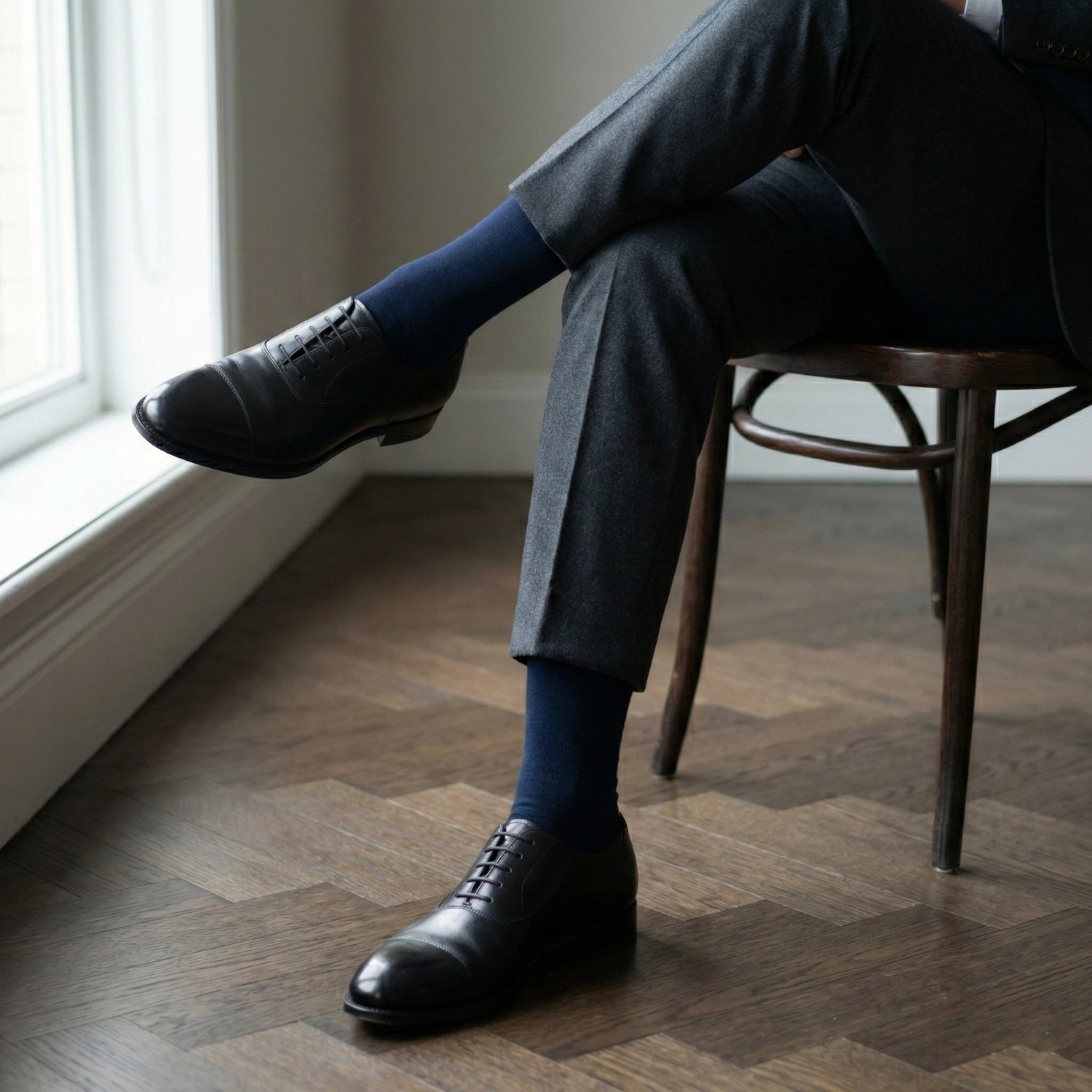
The Over-the-Calf (OTC) Rule: Gravity is the enemy of the short sock. To maintain dignity, a gentleman’s wardrobe should consist almost exclusively of Over-the-Calf socks. They stay up all day, creating a clean, uninterrupted line from trouser to shoe.
Visual Continuity:
- The Conservative Approach: Match your socks to your bespoke trousers (e.g., navy socks with navy trousers). This visually extends the leg line, making you appear taller.
- The Expressive Approach: Match your socks to a secondary colour in your tie or pocket square. This adds a dash of personality but requires confidence.
- The Exception: With loafers in summer, “invisible socks” (no-show socks) are permissible to achieve the barefoot look without the hygiene issues. However, ensure they are truly invisible.
To understand the strict etiquette of hosiery and why materials like Fil d’Ecosse matter, read our essential guide: [The Unsung Hero: Why Over-the-Calf Socks Are a Gentleman’s Essential].
Hardware & Leather: The Art of Synchronization
A coherent outfit is one where the eye flows easily without hitting “speed bumps” caused by clashing elements.
- Metal Matching: Your metals should speak the same language. If your belt buckle is silver, your cufflinks and watch case should also be silver (or white gold/platinum). Mixing gold and silver creates a disjointed appearance. Note: A wedding band is the only exception to this rule; it stands alone.
- Leather Coordination: The leather of your belt should always match the leather of your shoes in both colour and texture. A brown suede belt with black calfskin shoes is a fundamental mismatch.
- The Bespoke Advantage: It is worth noting that for the purist, the ultimate goal is to eliminate the belt entirely. Bespoke trousers are often commissioned with “side adjusters” rather than belt loops, creating a cleaner, unbroken waistline that flatters the silhouette.
Timepieces: Context and Clearance
A watch is the only piece of jewellery many men wear, yet it is frequently mismatched with the occasion.
- Dress vs. Sport: Just as you wouldn’t wear hiking boots with a tuxedo, you should avoid wearing a bulky, deep-sea diving watch with formal evening wear. A true dress watch is understated, typically with a leather strap and a slim profile that slips easily under a shirt cuff.
- The Cuff Interaction: This brings us to a critical intersection between accessories and tailoring. A common issue is a shirt cuff that gets snagged on a thick watch. When commissioning a bespoke garment, a detail-obsessed tailor will measure your wrist with the watch on, often making the cuff on the watch-wearing arm slightly wider (allowance) to accommodate the timepiece. This is the epitome of functional luxury.
To navigate the intricate rules of pairing watch cases and straps with your specific wardrobe, read our specialized guide: [Time and Style: Matching Your Timepiece to Your Tailoring].
Synthesis: Contextual Mastery
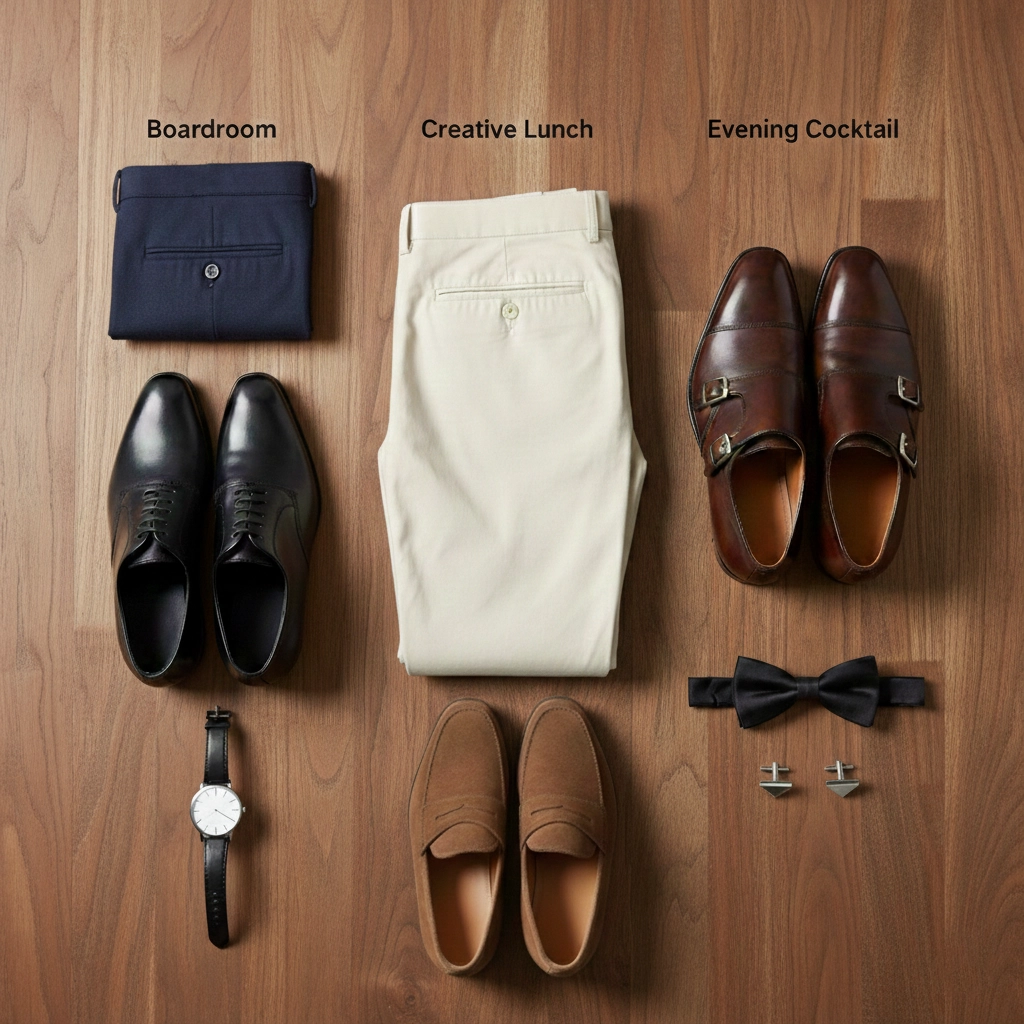
To demonstrate the transformative power of Men’s Shoes and Accessories, let us engage in a practical exercise. Imagine a single, foundational garment: a classic Single-Breasted Navy Bespoke Suit. Alone, it is merely blue fabric. But by altering the accessories, we can rewrite the script entirely, adapting the same bespoke suit to three distinct environments.
Scenario 1: The Boardroom (Strictly Business)
- The Goal: To project unshakable competence, authority, and trust.
- The Footwear: Black Calfskin Cap-toe Oxfords. The high shine and closed lacing signal discipline and adherence to protocol.
- The Neckwear: A Navy or Deep Burgundy Grenadine tie. The texture adds interest without being loud. The knot is a focused Half-Windsor or a tight Four-in-Hand.
- The Details: A crisp white linen pocket square, folded in a flat “TV Fold”. A slim dress watch on a black leather strap.
- The Result: You are the smartest person in the room. The look is “quiet,” allowing your words to take centre stage.
Scenario 2: The Creative Lunch (Smart Casual)
- The Goal: To appear approachable, worldly, and at ease.
- The Footwear: Dark Brown Suede Tassel Loafers or Penny Loafers. The suede texture softens the formality of the navy wool, while the brown creates a warmer, more inviting palette.
- The Neckwear: A silk Knit tie in a rust or forest green tone, or perhaps an open collar shirt if the setting permits.
- The Details: A patterned silk pocket square (perhaps paisley or geometric) stuffed nonchalantly in a “Puff Fold”. Colourful Over-the-Calf socks that pick up a hue from the pocket square.
- The Result: You respect the occasion but are not bound by rigid rules. This is the look of a man who enjoys the art of dressing.
Scenario 3: The Evening Cocktail (Social Elegance)
- The Goal: To look rakish, sophisticated, and ready for the night.
- The Footwear: Black Double Monk-straps or Wholecuts. The buckles catch the dim evening light, adding a touch of jewellery to your feet; while the Wholecuts offer a minimalist, uninterrupted silhouette.
- The Neckwear: A silver-grey Macclesfield print tie or a midnight blue satin tie. The sheen is now appropriate for the artificial lighting of a bar or event hall.
- The Details: A white silk pocket square with navy piping. Silver cufflinks that match the buckles of the Monk-straps, or simply coordinate with your watch case if wearing Wholecuts.
- The Result: You have transitioned from “worker” to “guest.” The suit remains the same, but the accessories announce that the business day is over, and the evening has begun.
Conclusion: The Philosophy of Care & Investment
True elegance is rarely defined by the price tag alone, but by the condition of what you wear. A pair of well-maintained, five-year-old Oxfords with a rich patina commands far more respect than a brand-new pair that has been neglected. This is the philosophy of stewardship.
To master Men’s Shoes and Accessories is to understand that purchase is merely the beginning. It involves the discipline of using cedar shoe trees to preserve form, the ritual of the weekly polish, and the patience to rotate your footwear to allow the leather to breathe. These are not chores; they are acts of respect for the craftsmanship involved.
Ultimately, style is a long game: an investment that pays dividends in confidence and reputation. It begins with the structural perfection of a bespoke suit, but it is completed by your attention to the smallest details. Build your collection slowly, choose quality over quantity, and care for what you own. In doing so, you elevate the ordinary act of dressing into a personal legacy.
DISCOVER PHYIGITAL BESPOKE TAILORING