Neckwear Narratives: Knots, Dimples, and the Pocket Square Debate
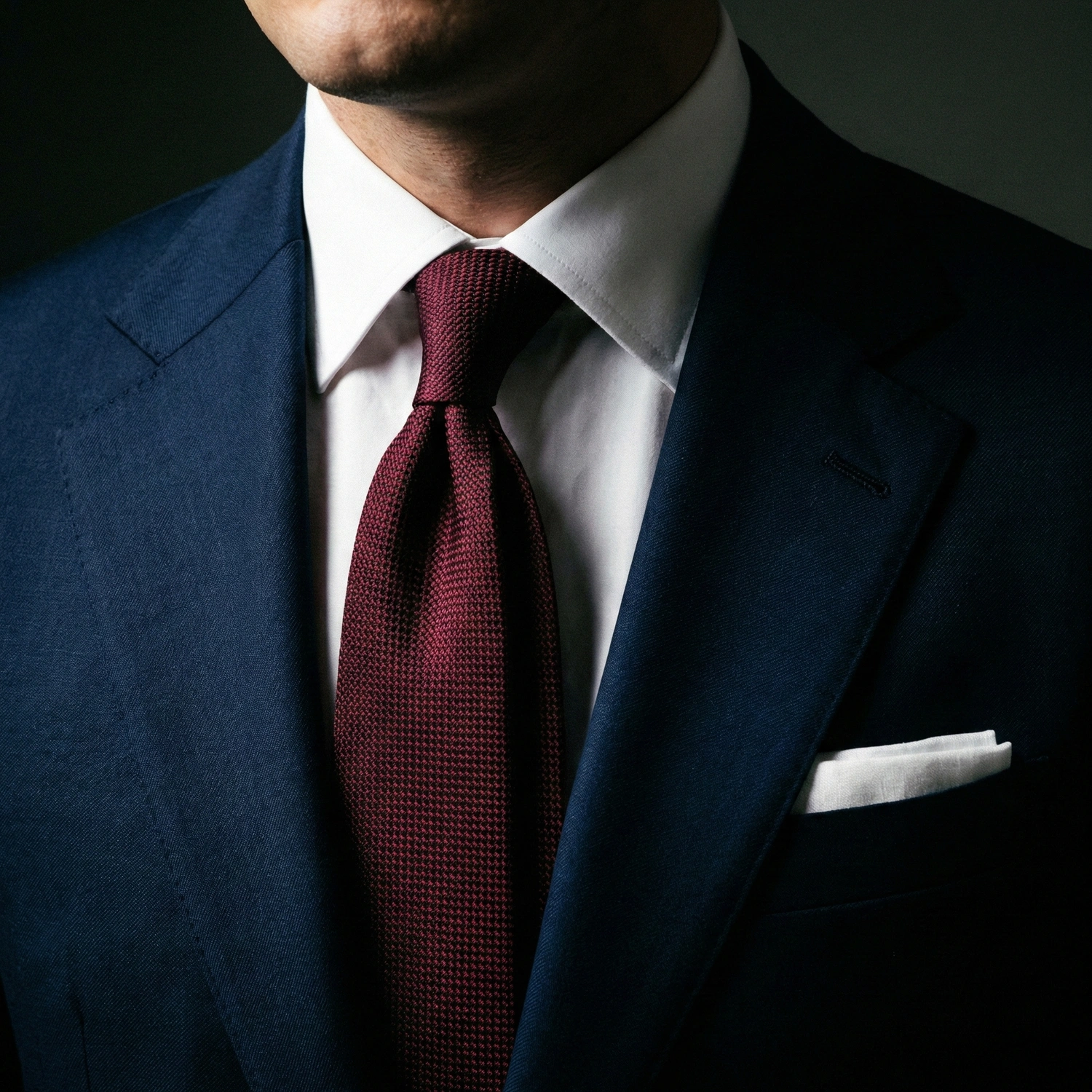
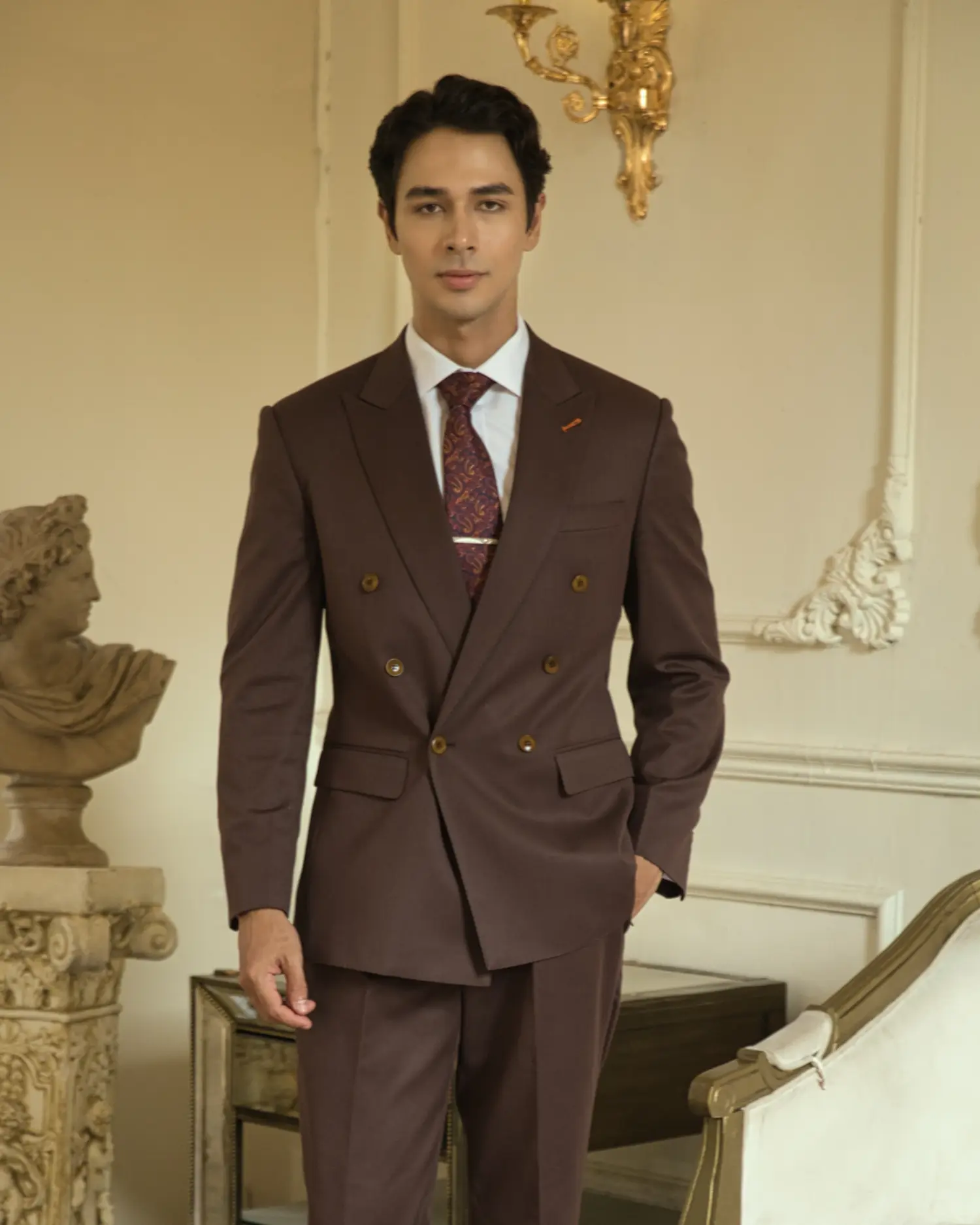
Your V-Zone is the focal point of every interaction. Yet, all too often, the authority of a flawless bespoke suit is quietly dismantled by a sloppy knot or a cheap, matching pocket square.
Whether elevating a staple navy suit or finishing a tuxedo, your choice of accessories is a declaration of intent. This guide cuts through the noise to master the essentials: the architecture of the knot, the art of the dimple, and the rules of the pocket square. These are your neckwear narratives; make them speak with precision.
The Architecture of the Knot
A tie knot is not merely a fastening device; it is the final punctuation mark of fine bespoke tailoring. Its shape, size, and finish must respond to the geometry of your collar and the proportions of your face. To treat it as an afterthought is to misunderstand the mechanics of elegance.
The Dimple: The Soul of the Knot
If the knot is the body, the dimple is the soul.
In technical terms, a knot tied flat creates a convex curve that deflects light, appearing two-dimensional and lifeless. By introducing a “dimple”, the central indentation just below the knot, you create a concave shadow. This simple manipulation adds depth, texture, and a sense of movement to the silk.
- Why it matters: A flat knot suggests you dressed in the dark. A dimpled knot suggests you care. It transforms a uniform into a personal signature.
- The Technique: This is not accidental. As you tighten the knot, place your index finger in the centre of the fabric just below the loop, pinching the edges with your thumb and middle finger. Pull tight while maintaining the pinch. The result should be a sharp, deliberate tie dimple that holds its shape all day.
The Four-in-Hand: Artful Asymmetry
Often dismissed by novices as “simple,” the Four-in-Hand is, in fact, the choice of the true connoisseur. Its beauty lies in its imperfection.
- The Profile: It creates a slender, elongated knot that is slightly asymmetrical (it “leans” to one side). This verticality is a powerful visual tool, helping to elongate the neck.
- The Context: This is the quintessential knot for the Italian concept of Sprezzatura studied carelessness. It pairs perfectly with a narrow Point Collar or a Button-down. Because it is less bulky, it allows the collar points to sit flush against the shirt, maintaining a clean line.
The Half-Windsor: The Boardroom Standard
When the occasion demands absolute symmetry and gravity, the Half-Windsor is the correct response.
- The Profile: It forms a substantial, equilateral triangle. It is tidy, disciplined, and balanced.
- The Context: This knot requires space. It is engineered for a Spread Collar or a Cutaway Collar, filling the wider gap between the collar points without overcrowding them.
- A Warning on the “Full Windsor”: Unless you have a particularly large head or an extremely wide collar, avoid the Full Windsor. It often produces a knot the size of a fist, which distracts from the face and looks pompous rather than powerful. In bespoke tailoring, proportion is king; a giant knot destroys that balance.
The Pocket Square Debate
If the tie anchors the outfit, the pocket square liberates it. It is the single most effective tool for demonstrating flair, yet it remains the most misunderstood accessory in the male wardrobe. The debate is not about whether to wear one, but how.
The Cardinal Sin: The Matching Set
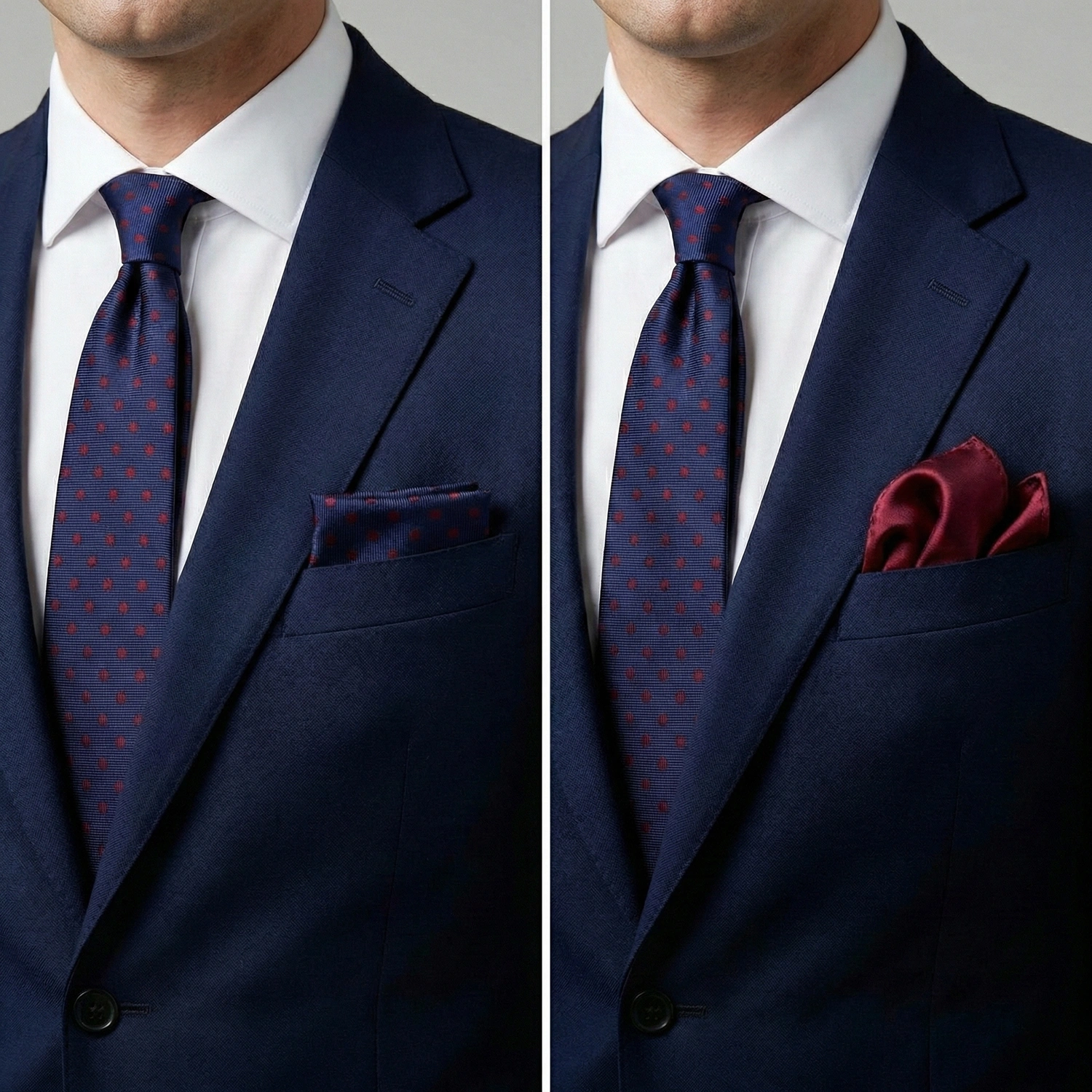
Let us begin with the absolute prohibition: Never, under any circumstances, wear a pocket square that is cut from the exact same cloth as your tie.
Department stores often sell these “matching sets” in boxes. To the connoisseur, this signals a lack of imagination. A tie and pocket square that match perfectly look forced, artificial, and reminiscent of a rental tuxedo at a high school prom. True style relies on “calculated nonchalance”: the appearance that you grabbed a square that just happened to look perfect, rather than one that was manufactured to match.
The Art of Complementing
The goal is harmony, not uniformity. Your pocket square should complement your tie, not clone it.
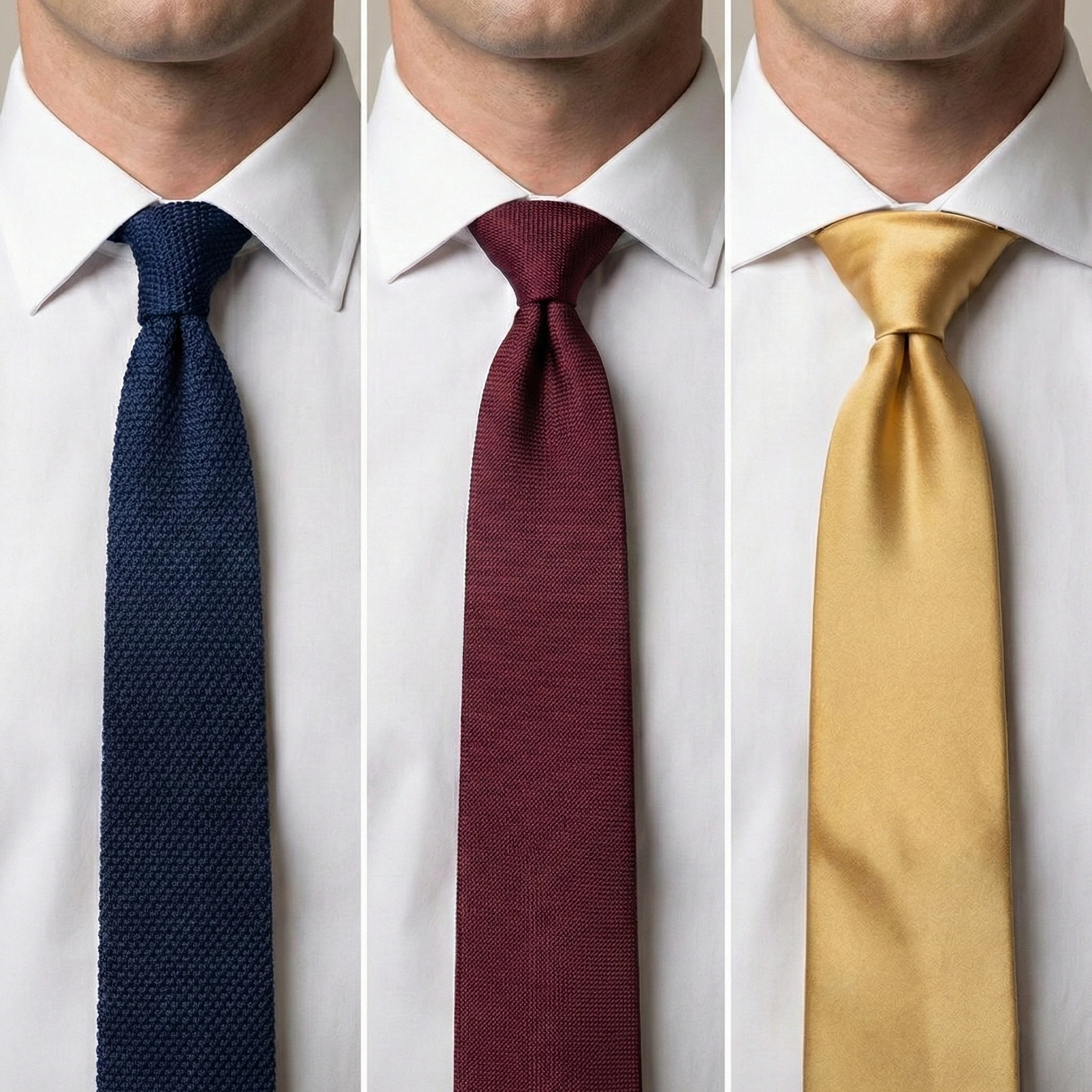
- The “Echo” Technique: The most sophisticated method is to pick up a secondary colour from your outfit. For example, if you are pairing a navy suit with a navy tie featuring small burgundy dots, your pocket square should not be navy; it should be solid burgundy to “echo” the dots.
- The Contrast: Alternatively, use the square to introduce a completely new but compatible colour. A deep forest green square can look stunning against a navy tie, providing a rich, earthy contrast to the blue.
The Fabric Hierarchy
Just as you wouldn’t wear brown shoes with a tuxedo, you must respect the hierarchy of fabrics.
- White Linen & Cotton (The Authority): While pure linen is the traditional standard, its tendency to crease can be frustrating. For a razor-sharp, architectural “TV Fold” that holds its shape all day, a high-quality Cotton or Cotton-Linen blend is often superior. It offers the requisite crispness for strict business without the stubborn wrinkles.
- Silk (The Socialite): Silk is all about movement and light reflection. It is fluid and voluminous. Best reserved for social occasions or dinner parties, fold it in a “Puff” to showcase the sheen and add a splash of vibrancy against a smooth worsted wool suit.
- Lightweight Wool & Silk-Wool Blend (The Winter Choice): When wearing heavy winter textures, standard silk looks too shiny. A lightweight wool (challis) or a Wool-Silk blend is the masterstroke here. The wool provides the necessary matte texture to harmonise with the jacket, while the silk content reduces bulk, ensuring the pocket remains streamlined.
Advanced Combinations
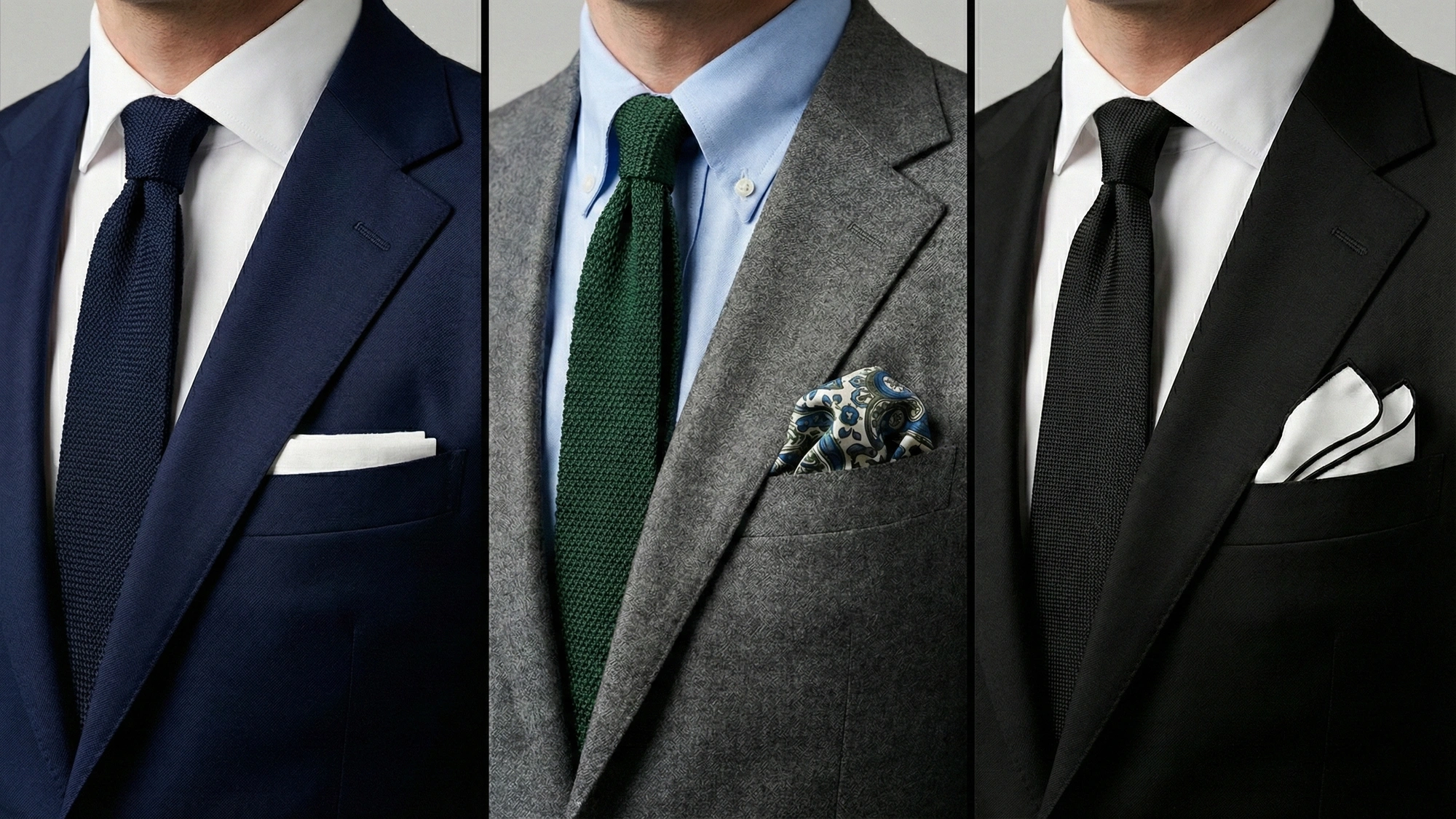
To move from theory to practice, we have curated three definitive combinations to help you write your own neckwear narratives that cover the spectrum of a gentleman’s life. These are “fail-safe” formulas used by the world’s best-dressed men.
The Business Power: Authority & Trust
This is the uniform of the decision-maker. It signals unshakable confidence without shouting for attention.
- The Foundation: A classic Navy Bespoke Suit (Single-breasted, Peak lapel).
- The Shirt: A crisp White Poplin with a substantial Spread Collar. It provides the cleanest possible backdrop for the tie.
- The Tie: Deep Burgundy Grenadine. The dark red signifies power, while the open weave of the grenadine silk keeps the look understated and matte.
- The Square: White Linen, folded in a razor-sharp TV Fold (straight line).
- The Narrative: “I am here to do business.” The stark contrast between the white linen/shirt and the navy jacket creates a clean, architectural line that commands respect.
- The Monochrome Variant: For the ultimate expression of corporate gravity, swap the burgundy tie for a Solid Navy Silk tie (one shade darker than your suit). This “tonal” look (Navy Suit, White Shirt, Navy Tie) is the preferred uniform of global finance leaders. It is clean, serious, and utterly fail-safe.
The Creative Director: Texture & Wit
For the man who works in media, architecture, or simply enjoys a weekend brunch, this combination replaces rigidity with “Sprezzatura.”
- The Foundation: A Mid-Grey Flannel or High-Twist Wool Suit.
- The Shirt: Light Blue Chambray or a subtle Bengal Stripe. The texture or pattern adds visual interest without overwhelming the eye.
- The Tie: Forest Green Silk Knit (square bottom). The knitted texture adds a touch of playfulness and softens the formality of the bespoke suit.
- The Square: A Silk Paisley or Geometric print (picking up creams, greens, and rusty oranges), stuffed nonchalantly in a Puff Fold.
- The Narrative: “I understand the rules, and I know how to bend them.” It shows artistic flair and a mastery of colour harmony.
The Monochrome Master: Depth in Darkness
Monochrome is often mistaken for boring. However, when executed with varying textures, it is the height of modern sophistication.
- The Foundation: A Black or Charcoal Suit.
- The Shirt: Crisp White Poplin to create stark, formal contrast, or a Black Silk shirt for a daring, seamless evening look.
- The Tie: Black Garza Grossa (Large Weave) Grenadine.
- The Square: White Silk with black hand-rolled piping (if wearing white shirt), or a dark grey wool square (if wearing black shirt).
- The Narrative: “Strictly elegance.” Here, you are removing colour to let the texture speak. The “crunchy” texture of the grenadine tie prevents the outfit from looking flat and elevates it to evening wear excellence.
Conclusion: Mastering Your Neckwear Narratives
True style is often defined by what is not immediately obvious. A perfectly dimpled knot or a complementary pocket square are not mere decorations; they are the non-verbal language of your character, signaling a man who pays attention to the smallest details.
Your V-Zone is now secured, speaking with clarity and authority. But the narrative does not end here. A single weak link in your ensemble can still undermine the entire aesthetic.
To view the complete landscape of accessory mastery and understand how these elements interact with the rest of your wardrobe, return to our definitive manifesto: [Completing the Masterpiece: The Definitive Guide to Men’s Shoes and Accessories].
DISCOVER PHYIGITAL BESPOKE TAILORING