The Unsung Hero: Why Over-the-Calf Socks Are a Gentleman’s Essential
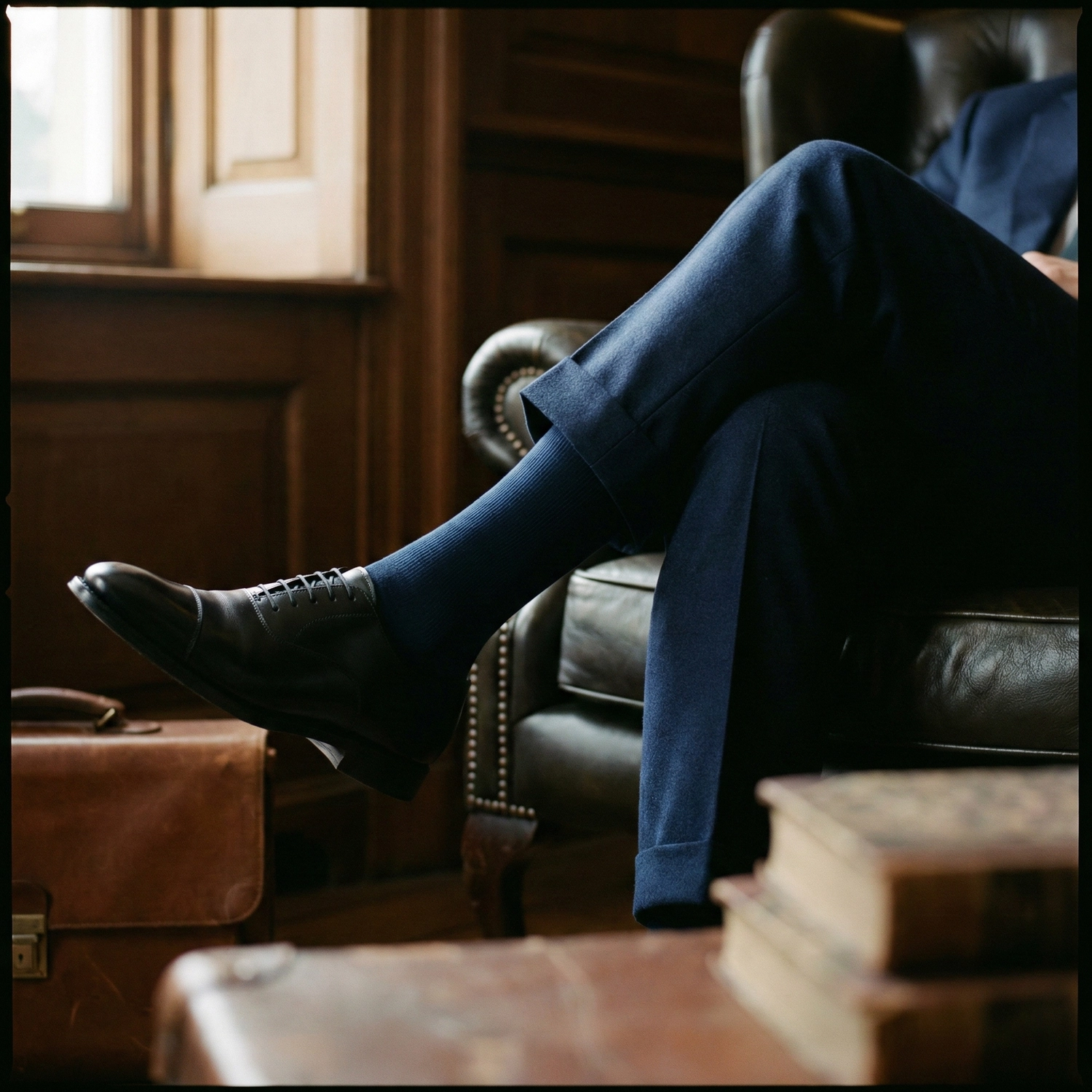
Imagine the scene: You are in a high-stakes meeting, your bespoke suit is impeccable, and your shoes are polished to a glass-like shine. Then, you cross your legs. In an instant, the hem rises to reveal a flash of pale, hairy skin between your short sock and trouser cuff. This “Gap of Doom” immediately dismantles your polished image, downgrading you from a commanding professional to a schoolboy who has outgrown his uniform. It is a harsh truth of menswear: the authority of a fine garment is often undone by the smallest oversight.
Hosiery is rarely the first thought, yet it acts as the critical bridge between your trousers and your footwear. It is the unsung hero of the silhouette, ensuring an unbroken line of colour and texture regardless of your movement. This guide explains why upgrading to Over-the-Calf (OTC) socks is not merely a stylistic preference, but a mandatory evolution for the modern gentleman, ensuring that your foundation remains as solid as your tailoring.
The Etiquette of Continuity
In the codified world of classic menswear, the overarching goal is continuity. A well-cut bespoke suit is designed to create a seamless vertical line that elongates the body and directs the viewer’s eye upward toward your face.
A flash of bare skin at the ankle destroys this illusion instantly.
- The Visual Break: When you sit down, your trousers naturally rise, this is simple physics. If your socks are too short, they expose the most awkward part of the male anatomy: the hairy shin. In a professional setting, this “flesh gap” creates a high-contrast visual break that drags attention down to your ankles.
- The Professional Standard: It signals a lack of preparation, akin to leaving a shirt untucked. The rule is absolute: Your skin should never be visible when you are dressed in a suit, regardless of how you move. Whether crossing your legs or reclining, the transition from trousers to shoes must remain unbroken.
Gravity and Engineering
If the problem is the disruption of the line, the culprit is almost always gravity. Most men rely on “mid-calf” socks, which sit at the widest part of the calf muscle. This is a fundamental design flaw.
- The Anatomy of Failure: As you walk, the natural expansion and contraction of the calf muscle, combined with gravity, force the fabric downward. Within minutes, a mid-calf sock collapses around the ankle, requiring constant, undignified pulling up.
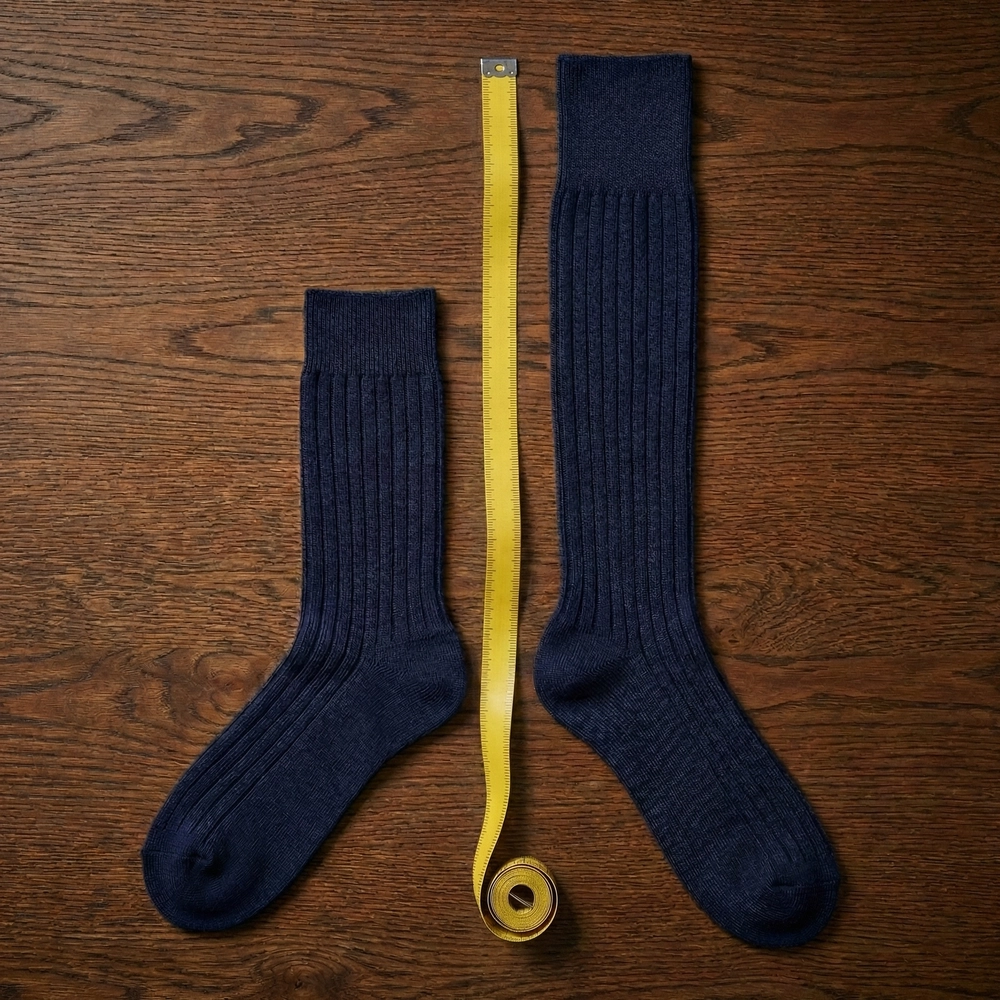
- The OTC Solution: Over-the-Calf socks solve this through simple engineering. By extending over the calf and resting just below the knee, the sock anchors itself on the narrowing part of the leg. The calf muscle acts as a natural stopper, preventing the fabric from sliding down.
- The Hidden Benefit: This “self-suspending” mechanic ensures the sock stays taut all day without tight elastic. Furthermore, it creates a smooth layer that allows your bespoke trousers to glide effortlessly when you stand or sit, preventing the fabric from “catching” on bare skin (static cling).
Material Matters
Length is non-negotiable, but comfort depends entirely on the fiber. A gentleman’s rotation should follow the seasons and the texture of his trousers.
The Business Standard: Fil d’Ecosse (Cotton Lisle)
For the majority of your bespoke suits (worsted wool) and formal business settings, especially in warmer months, Fil d’Ecosse socks are the gold standard.
- The Science: This is Egyptian cotton that has been combed, twisted, and mercerised to remove fuzzy fibers.
- The Result: A sock that is incredibly fine, durable, and possesses a subtle, silk-like sheen. It is thin enough to fit perfectly inside a snug Oxford shoe without altering the fit, while offering superior breathability for long days in the office.
The Winter Essential: Merino Wool
When the temperature drops or when wearing textured fabrics like Flannel, Tweed, or Velvet, the shine of cotton can look out of place.
- The Texture: Merino wool socks offer a matte, rich finish that harmonises with heavier cloth.
- The Performance: Unlike coarse wool, Merino is ultra-fine and non-itchy. It is nature’s temperature-regulating miracle: keeping you warm outdoors yet surprisingly breathable and cool in heated offices. It actively wicks moisture to keep feet dry and odour-free all day.
The Warning: Synthetics
Avoid socks with high polyester or nylon content (anything above 5-10% for elasticity is a red flag). Synthetics trap heat and moisture, leading to discomfort and odour. In the world of fine tailoring, natural fibers are the only acceptable currency.
The Chromatic Code
Once the length and material are secured, the final hurdle is colour. Contrary to popular belief, socks should not be an afterthought; they are a tool for manipulating proportion.
Rule #1: The Leg Extension (Match Your Trousers)
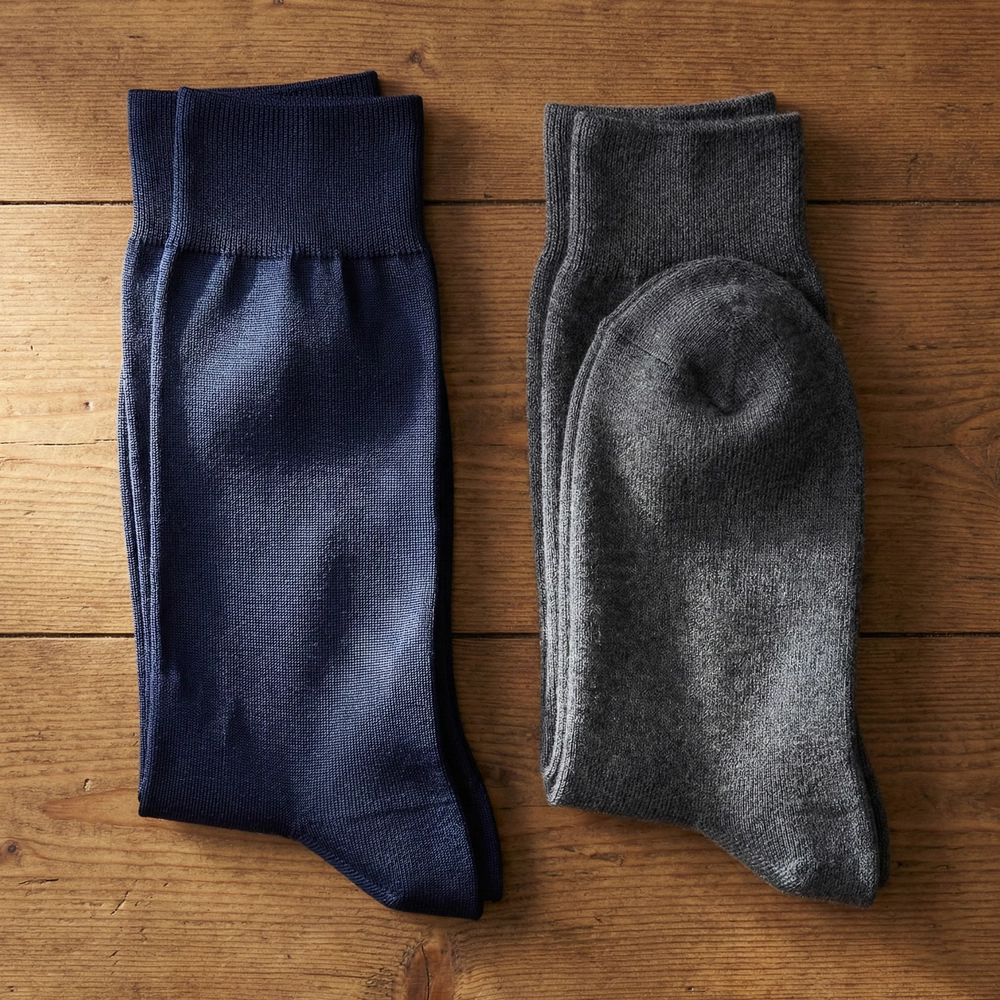
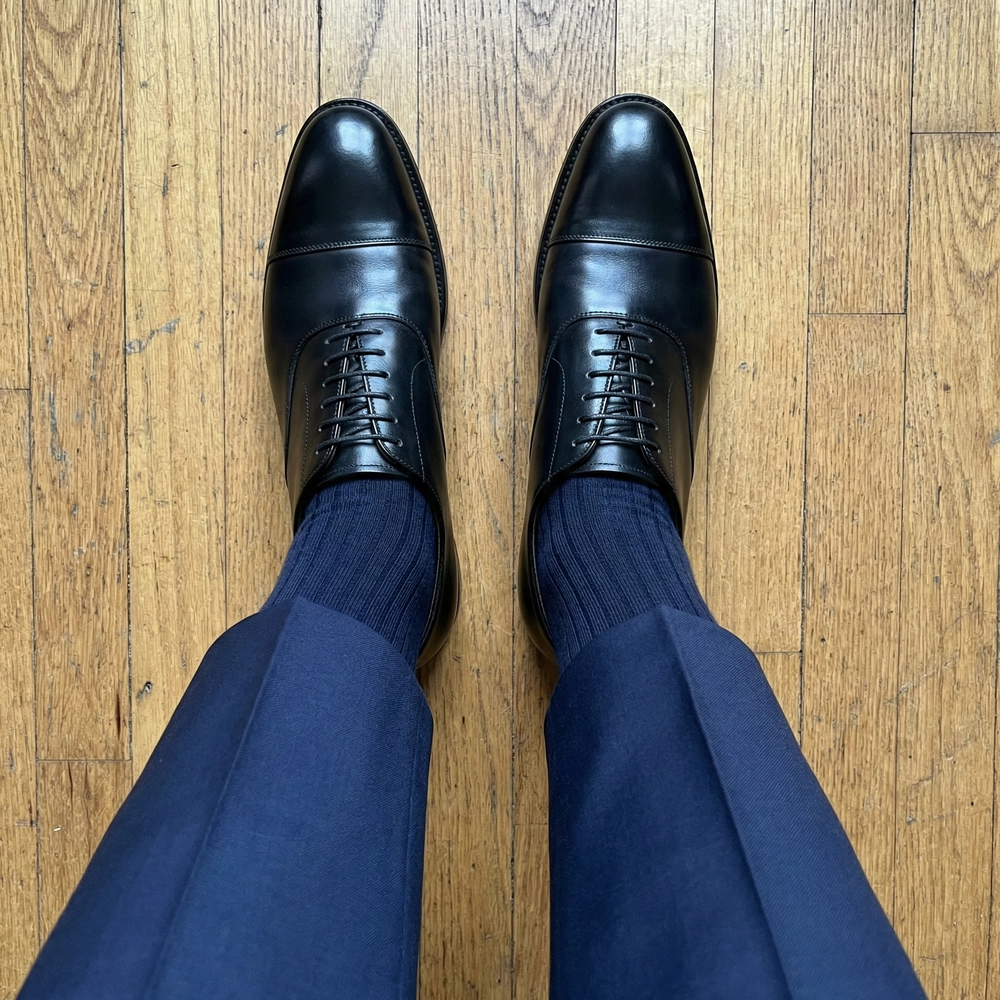
This is the Golden Rule of menswear. By matching your socks to your bespoke trousers (or choosing a shade slightly darker), you create an unbroken vertical line from your waist to your shoes.
- The Effect: This visually elongates the leg, making you appear taller and slimmer.
- The Application: If you are wearing a Navy suit, wear navy socks. If Charcoal, wear charcoal socks. It is fail-safe, authoritative, and always appropriate for business.
Rule #2: The “Bootie” Trap (Do Not Match Your Shoes)
A common mistake is matching socks to footwear (e.g., Grey trousers + Brown socks + Brown shoes). This visually merges your foot and ankle, creating the illusion that you are wearing high-top boots. It “cuts” the leg line at the ankle, making you look shorter.
Exception: Black trousers with black shoes (where the sock must inevitably be black).
Rule #3: The Advanced Coordinate (Match Your Accessories)
For the gentleman who wishes to step beyond the monochrome, socks can be used to echo the upper half of the outfit.
- The Technique: Instead of matching your trousers, select a sock colour that complements a secondary tone in your tie or pocket square. For example, a deep burgundy sock can look stunning with a Navy suit if it picks up the burgundy notes in your tie.
- The Context Warning: Proceed with caution. This approach is best reserved for “Business Casual” days, creative industries, or social events. For high-stakes board meetings, job interviews, or strict corporate environments, the authority of Rule #1 (Matching Trousers) always prevails.
- The Warning: Subtlety is key. The goal is a “nod” to the accessory, not a loud shout. Ensure the colour is muted (e.g., forest green, maroon, burnt orange) rather than bright and distracting.
Rule #4: Texture Over Loud Patterns
While novelty socks with pizzas or cartoon characters are strictly forbidden, subtle patterns distinguish the connoisseur.
- The Safe Bet: Shadow Ribs. For the boardroom, nothing beats a solid colour with a ribbed texture (vertical lines knitted into the fabric). It adds depth and visual interest without breaking the formality. It is understated, masculine, and elongates the leg further.
- The Micro-Pattern: Small, classic motifs like Pin Dots or Herringbone in muted tones (e.g., grey dots on navy) are excellent for adding personality to a business suit.
- The Warning on Argyle: Large, colourful diamonds (Argyle) or bold stripes are generally too casual for worsted wool suits. Save them for weekend wear with denim, corduroy, or tweed jackets.
The Invisible Exception (Loafers & Summer)
While the Over-the-Calf rule is paramount for business, the relaxed nature of summer style allows for a specific stylistic detour.
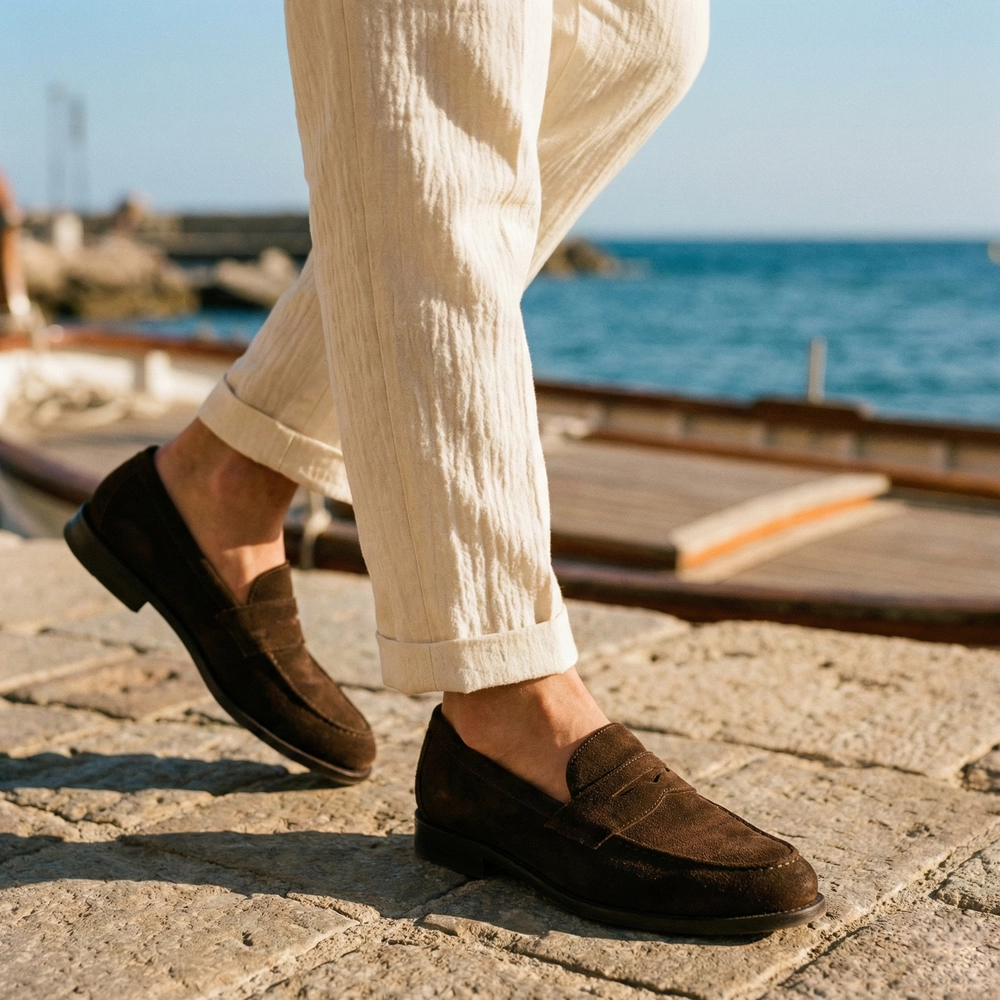
- The Context: The “sockless” look is a staple of Italian Riviera style. It is perfectly suited for Loafers (Penny or Tassel) worn with Linen suits, Seersucker, or cuffed cotton trousers during the warmer months or at resort settings.
- The Formal Prohibition: Note: This exception applies strictly to casual summer tailoring. Never attempt the “sockless” look with a formal worsted wool business suit; the clash in formality is jarring and inappropriate for the boardroom.
- The Hygiene Mandate: Never wear leather shoes barefoot. Human feet produce moisture that destroys the inner leather lining and breeds bacteria.
- The Technical Solution: Invest in high-quality “Invisible Socks” (No-show socks) with a silicon grip at the heel. “Invisible” means invisible. If the rim of the sock peeks out above the shoe, the illusion is ruined. If you cannot find a pair that stays hidden, revert to Over-the-Calf socks.
Conclusion: The Absence of Distraction
True elegance is defined by what you do not have to worry about. By securing your foundation with Over-the-Calf socks, you banish the anxiety of the “Gap of Doom” and the undignified need for constant adjustment. You are free to focus entirely on the conversation at hand, knowing your silhouette remains unbroken.
A gentleman’s wardrobe is built on these quiet assurances. Now that your foundation is secure, ensure the rest of your accessories are speaking the same language. Return to our definitive manifesto: [Completing the Masterpiece: The Definitive Guide to Men’s Shoes and Accessories].
DISCOVER PHYIGITAL BESPOKE TAILORING