The Ultimate Guide to Phygital Tailoring for the Muscular Build: Mastering the V-Taper Suit
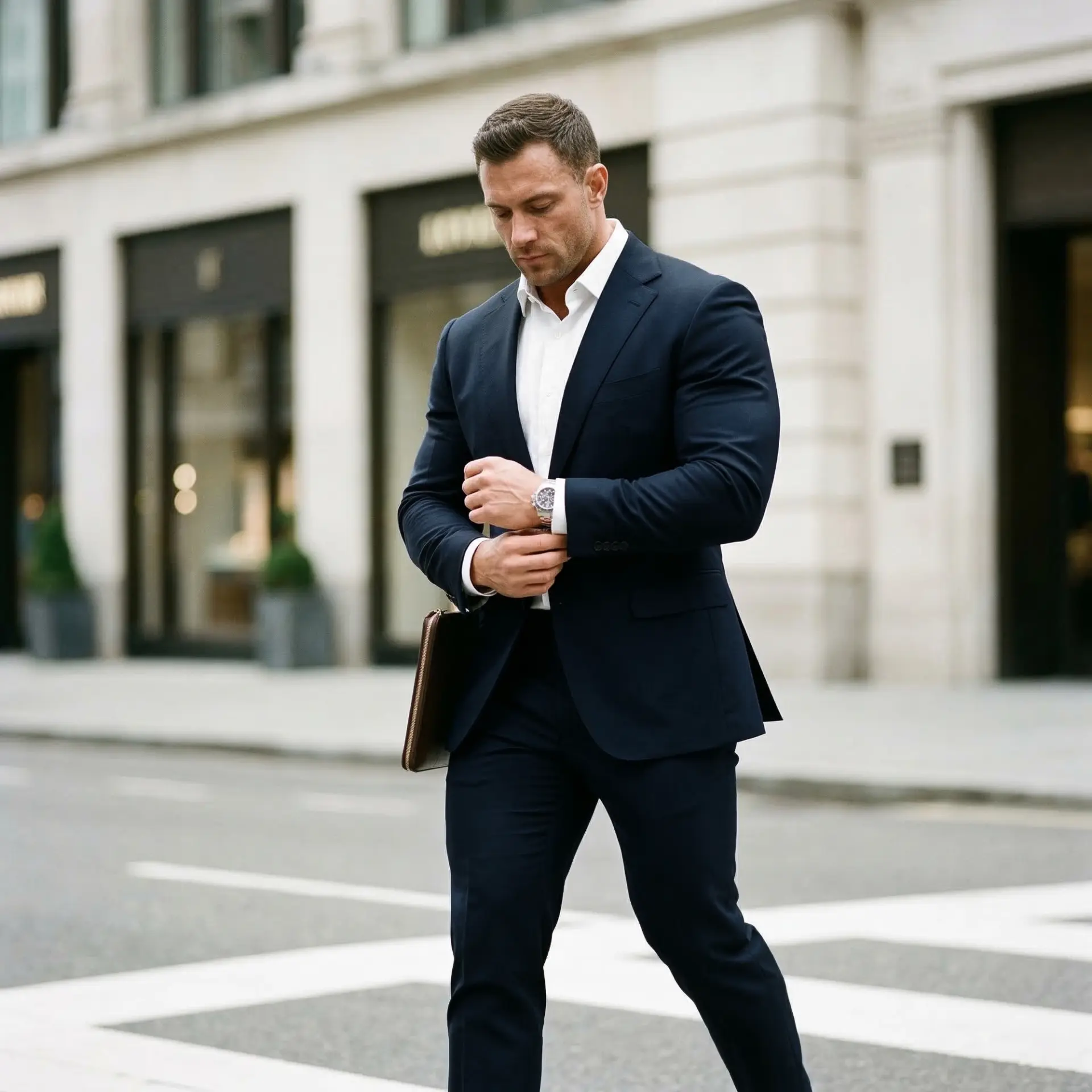
For the high-performer, success is not just about the goals achieved, but the discipline carried in every fiber of one’s being. You have spent years sculpting a silhouette that commands respect: a powerful V-taper that serves as a visual resume of your persistence. Yet, a frustrating irony persists: the more you refine your physique, the more the world of traditional fashion seems to retreat.
This guide is not just about clothing; it is a strategic blueprint for the modern elite who refuses to settle for the “average.” We introduce the era of Phygital Tailoring, a revolutionary union of precise anthropometry and artisanal mastery. It is time to stop viewing your athletic build as a “fit problem” and start seeing it as the ultimate sartorial opportunity. Your suit should not just fit your body; it should honor your journey.
The Outlier Paradox: Why Your Discipline is a “Problem” for Modern Fashion
While a powerful V-taper is a masterpiece of discipline and a sign of leadership to the world, the traditional garment industry often treats your hard-earned success as a “technical error.”
- The 99% Mold: Most manufacturing systems are engineered for a sedentary, average silhouette, leaving those with a 1% athletic physique as “outliers” in a mass-market world.
- The Aesthetic Penalty: Attempting to force an athletic frame into a generic template results in a structural misalignment that camouflages your physique rather than complementing it.
- The Failure of “Custom” Tweaks: Standard Made-to-Measure (MTM) often relies on limited adjustments that fail to redefine critical areas, such as armhole depth, sleeve pitch, or the specific muscular curvature of developed lats (Scapular Prominence).
- The Frustration Cycle: This misalignment leads to a cycle of constant returns due to poor fit, or the tedious necessity of local alterations that rarely achieve the level of elegance you envisioned.
In this paradigm, you are frequently forced to choose between a garment that compromises your presence or a tailoring process that fails to respect the reality of your body.
The Fit Dilemma: Compromising Between Fit and Time
The modern high-performer faces a frustrating zero-sum game when dressing formally: you must either settle for garments that distort your hard-earned physique or surrender countless hours to traditional tailoring. The current landscape forces a compromise across three flawed avenues:
The Mass-Market Trap (Ready-to-Wear)
Ready-to-wear clothing relies on patterns drafted for a theoretical average, creating a generic silhouette that ignores athletic reality.
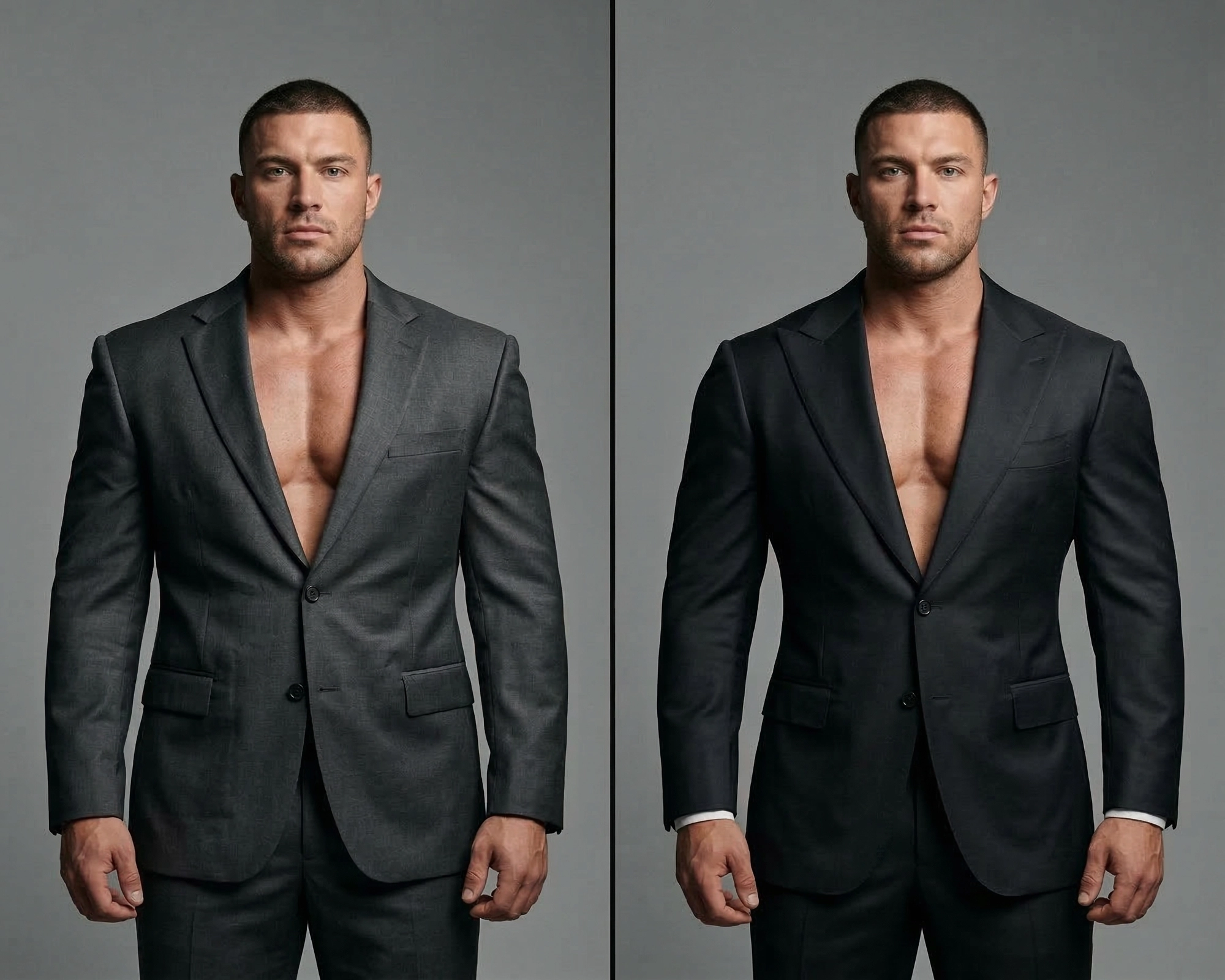
- The Geometry Mismatch: Standard suits assume a 6-inch “Drop” (the difference between chest and waist). A muscular V-taper often demands a 10 to 14-inch drop. Sizing up for the chest creates a structural dead zone of excess fabric at the midsection.
- The Shoulder-Lat Trap: Developed lats and capped deltoids cause the jacket to pull across the upper back (tensile stress) and the lapels to bow outward.
- The Lower Body Dilemma: Fitting developed quads creates a massive, unfixable gap at the trouser waist.
- The Reality: This fundamental anatomical misalignment effectively camouflages your physique under a boxy, industrial silhouette.
The “Custom” Illusion (Online MTM)
Seeking an escape, many turn to Online Made-to-Measure (MTM). Yet, for a muscular build, this is often an exercise in “tweaked industrialism.”
- The Standard Block Limitation: MTM does not draft a new pattern from scratch. It merely adds or subtracts inches from a pre-existing industrial template.
- 2D Fixes for a 3D Body: It relies on basic circumference measurements that fail to capture the sculptural depth of an athlete, such as the rotation of a shoulder or the curvature of a developed upper back.
- The Reality: MTM acts as a band-aid solution. It provides the illusion of custom but remains structurally misaligned with a high-performance frame.
The “Time Tax” of Traditional Bespoke
Bespoke tailoring is universally regarded as the gold standard, offering the exact architectural precision a V-taper requires. However, traditional bespoke tailoring carries a heavy, often invisible price:
- The “Fitting Fatigue”: Achieving a true bespoke fit demands an exhaustive cycle of 3 to 5 in-person appointments.
- The Opportunity Cost: For an individual who manages life with surgical precision, this geographical tethering presents an unacceptable loss of time and momentum.
- The Strategic Reality: Traditional tailoring assumes that luxury must be slow, failing to recognize that for the modern elite, efficiency is the highest form of luxury.
The Phygital Solution: Bespoke Convenience Anywhere
The shift toward Phygital Tailoring is built on a simple, powerful premise: combining the ease of scanning technology with the unparalleled quality of a bespoke suit. It removes the physical barriers of the past, allowing for a true bespoke tailoring experience regardless of location.
Technology Meets Handcraft
In this model, technology does not replace the tailor; it simply modernizes the measurement process to respect the client’s time and location.
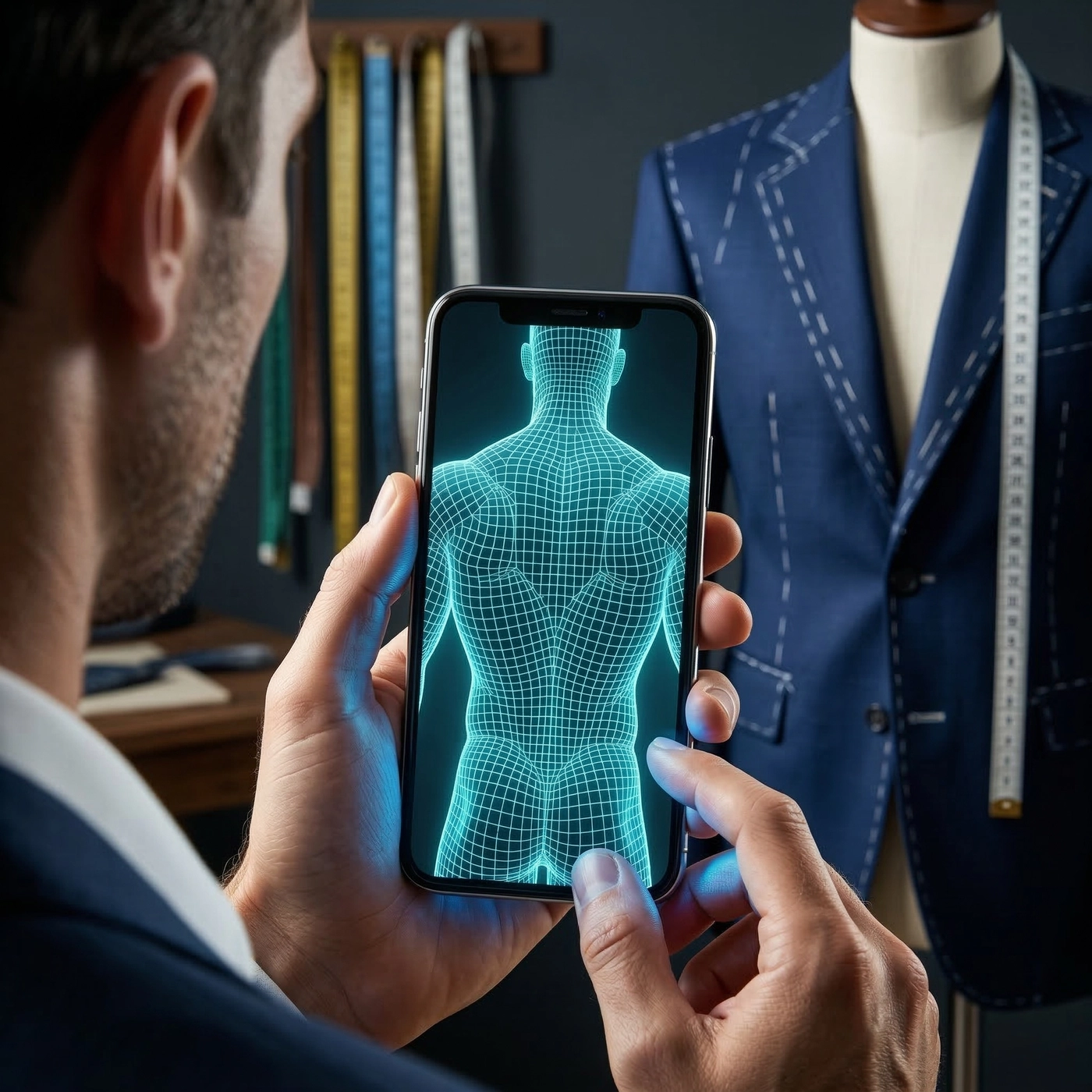
- Scanning over Tape Measures: Instead of lengthy manual measuring sessions that require physical presence at an atelier, a quick smartphone scan captures the necessary body data. This ensures a stable foundation for the tailor to work from, without the inconsistencies of a manual tape.
- Global Accessibility: The primary advantage is the freedom of location. Whether at home, in an office, or traveling, anyone can initiate a bespoke commission. The “shop” is essentially brought to the client, making high-end tailoring accessible anywhere in the world.
- True Bespoke Construction: While the data is captured digitally, the execution remains traditional. Master tailors use these digital measurements to draft an individual pattern from scratch. The suit is still hand-cut and hand-sewn, maintaining the soul of artisanal craftsmanship.
The Modern Workflow: Efficiency Without Compromise
This streamlined approach, pioneered by platforms like Rosie Hong bespoke online shop, replaces weeks of logistical friction with a straightforward, four-step journey:
- Personal Selection: The process starts online, where the client selects fabrics and design details to match their personal taste.
- Convenient Scanning: Precise measurements are captured via a smartphone scan in a matter of seconds, from any preferred location.
- Traditional Tailoring: Artisans use the digital data to hand-make a garment that is structurally unique to the individual’s physique.
- Direct Delivery: The finished bespoke suit is delivered directly to the client, fitting perfectly.
By integrating 3D technology into the bespoke tradition, the process becomes a seamless part of a modern lifestyle rather than a logistical burden. However, achieving a perfect fit through technology is only the first step. To truly master your aesthetic, you must also apply the right “Mastering the V-Taper: Definitive Styling Tips for Muscular Silhouette” to complement a high-performance frame.
Architecting the V-Taper: A Masterclass in Muscular Styling
Possessing a flawless anatomical fit through technology is the foundation, but the true art of a bespoke suit lies in the design choices. For an athletic physique, the goal of styling is to harmonize proportions by celebrating the V-taper without allowing the muscularity to overwhelm the elegance of the bespoke suit.
Design & Silhouette: Working with the Frame
The architecture of the bespoke suit should complement the body’s natural lines rather than adding unnecessary bulk.
- The Soft Shoulder (Spalla Camicia): A muscular build already possesses natural “padding” in the form of developed deltoids. Heavily padded shoulders should be avoided as they create a boxy, robotic silhouette. Instead, a natural or “unstructured” shoulder allows the jacket to drape over the muscle, providing a cleaner and more sophisticated line.
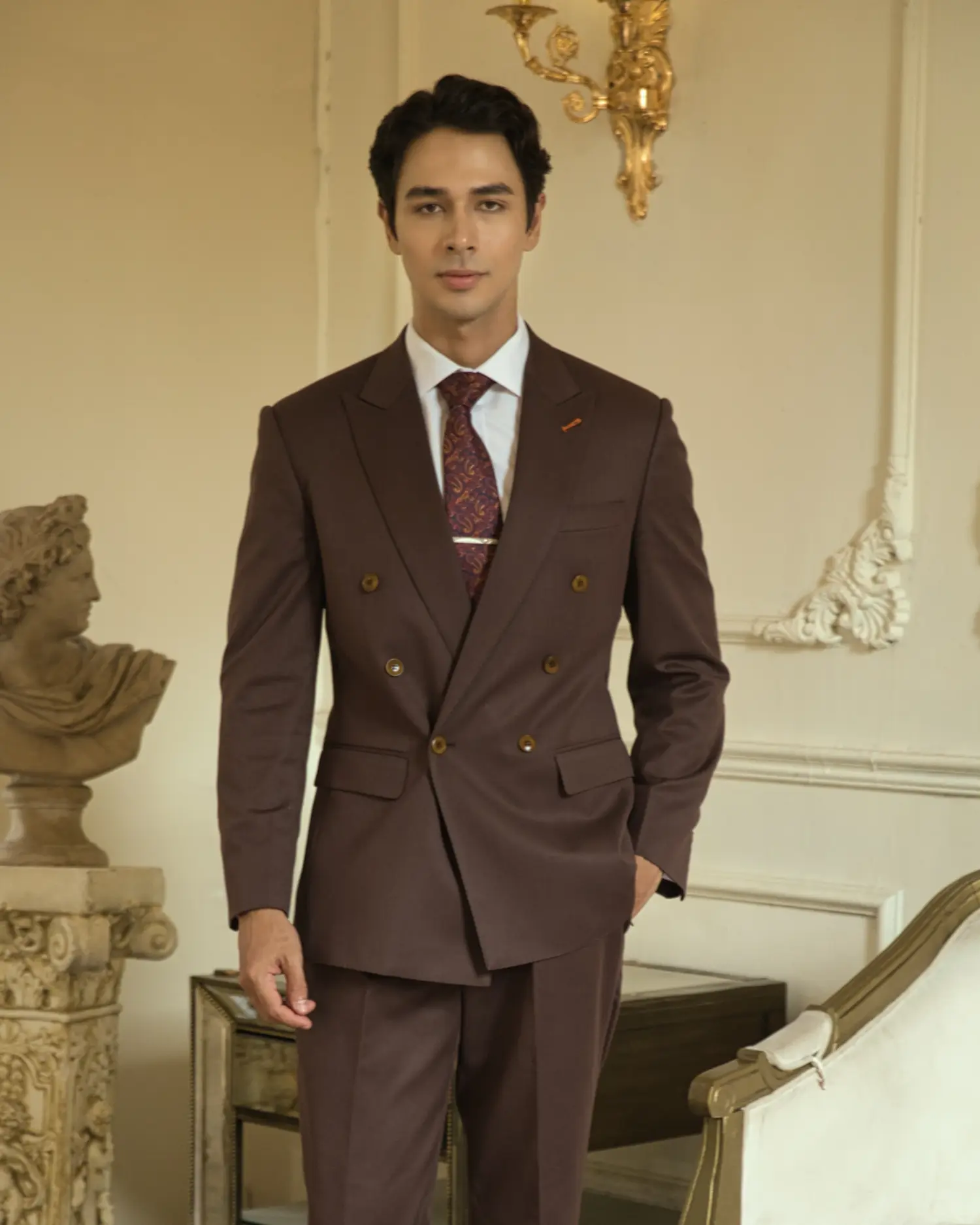
- Proportional Lapels: Small or “skinny” lapels are the enemy of a broad chest. They appear lost against a large torso, making the wearer look disproportionately oversized. Wide lapels, whether Notch or Peak, create a balanced visual bridge between the shoulders and the waist, reinforcing the V-shape.
- A Lower Button Stance: Positioning the jacket’s closing button slightly lower creates a deeper “V” in the chest area. This elongates the torso and draws the eye downward, preventing the upper body from appearing too “top-heavy.”
- Pleated Trousers for Mobility: While flat-front trousers are common, single or double pleats are highly functional for those with developed quads and glutes. Pleats provide the necessary “room to breathe” when sitting or moving, preventing the fabric from straining while maintaining a sharp, tapered leg line.
Fabric Selection: Breathability and Movement
Muscle tissue generates significant metabolic heat, and a developed frame puts more tension on seams. Therefore, material choice is a matter of both comfort and durability.
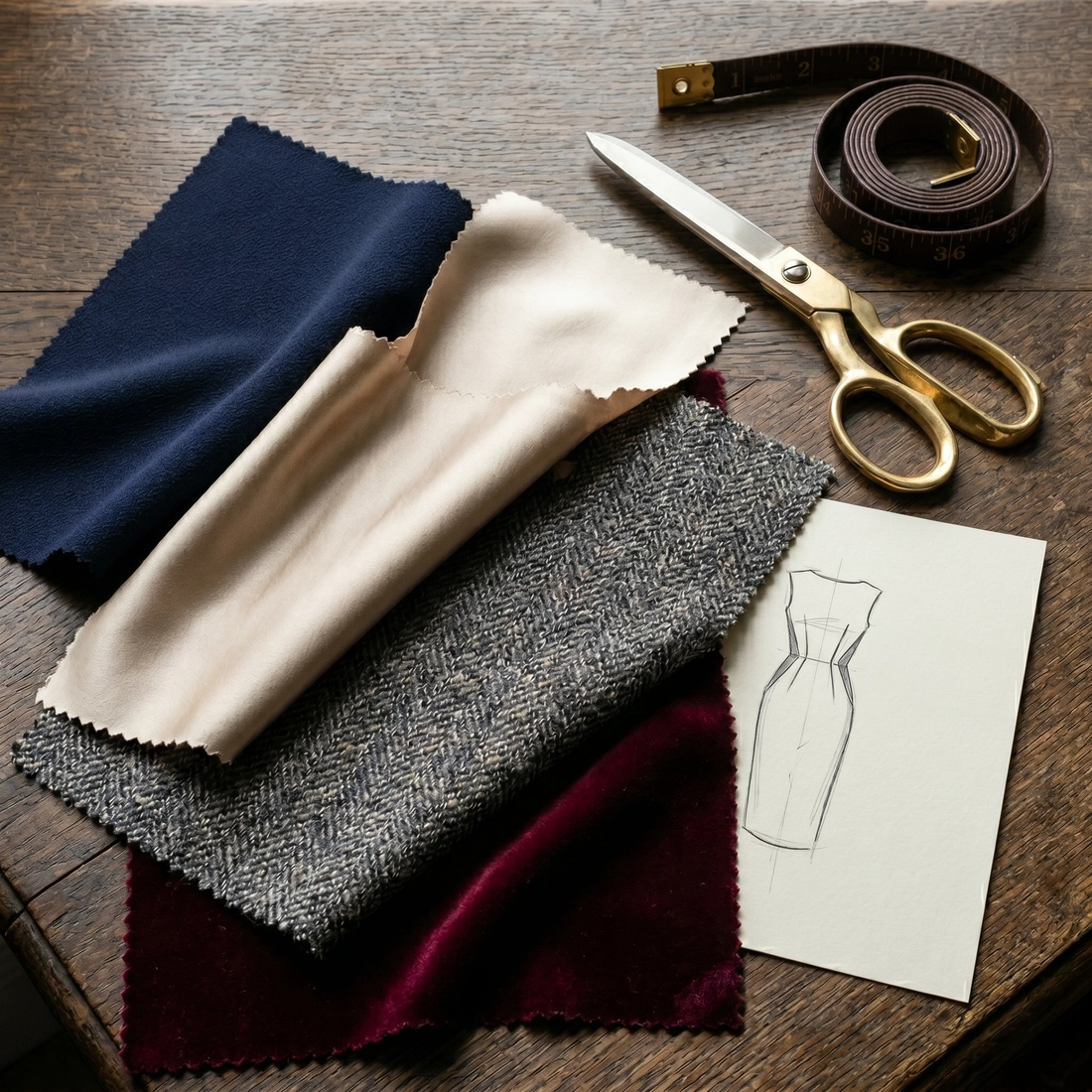
- The Super Wool “Sweet Spot” (Super 110s – 130s): In bespoke, higher isn’t always better. While Super 150s+ offer an exquisite feel, their ultra-fine fibers are often too fragile for the tension of developed deltoids or quads. We recommend the “Performance Sweet Spot” of Super 110s to 130s for the perfect equilibrium between a luxurious drape and the resilience to withstand an active physique.
- High-Twist Wools: Fabrics like high-twist “traveler” wools are ideal for the athletic build. They are highly breathable, crease-resistant, and possess a “natural stretch”, allowing the bespoke suit to move in harmony with your muscles without the need for synthetic fibers.
- Weight Management: Light-to-medium weight fabrics are preferred. Heavy textiles add unnecessary volume to an already large frame, potentially making the wearer look “bulky” rather than “fit.” The goal is to highlight lean power, not obscure it.
While weight and weave are critical, the science of performance textiles goes even deeper, from natural stretch physics to specialized technical blends. For a comprehensive analysis of the materials that power a dynamic lifestyle, read our dedicated guide: “Beyond the Fit: High-Performance Fabrics Designed for Active Movements“.
Colors and Patterns: The Power of Subtlety
The right palette can enhance the presence of an athletic build without being distracting. Solid colors are the gold standard for this physique, providing the most authoritative and streamlined look.
- The Dominance of Solids: Solid navy, charcoal, or deep forest green should be the foundation of a muscular wardrobe. These solid fabrics create a continuous visual line that emphasizes the silhouette’s strength without any visual distortion.
- Subtle Textures (Herringbone & Microcheck): If a purely solid look feels too simple, subtle textures are the best alternative.
- Herringbone: Provides a classic, directional texture that adds depth to the suit without adding width.
- Microcheck: A very small-scale check that looks like a solid from a distance but reveals sophisticated detail up close.
- Matte Finishes: Always opt for matte over high-shine fabrics. Matte finishes provide a more grounded look, whereas shine can catch the light on muscle peaks in an exaggerated, unflattering way.
By mastering these styling principles, the bespoke suit becomes more than just a garment that fits, it becomes a strategic tool that perfectly translates a high-performance lifestyle into a powerful visual identity.

Conclusion: The Efficient Gentleman
A suit is a visual extension of the man inside: a harmony between a high-performance physique and a refined, personal aesthetic.
Today, true luxury is defined by respected choice and optimized time. The “Efficient Gentleman” no longer accepts the “Time Tax” or the “Anatomical Misalignment” of mass production. By merging precision with the heart of bespoke tailoring, the anatomical challenges of the muscular build are finally resolved. Phygital Tailoring ensures your bespoke suit is as precisely engineered as your physique.
Attire should be as precisely engineered as the physique and as unique as the personal taste. When style is built on a foundation of accuracy and intentional design, it no longer limits performance; it enhances it.
DISCOVER PHYIGITAL BESPOKE TAILORING