Why Linen Is the Smart Choice for Summer Suits
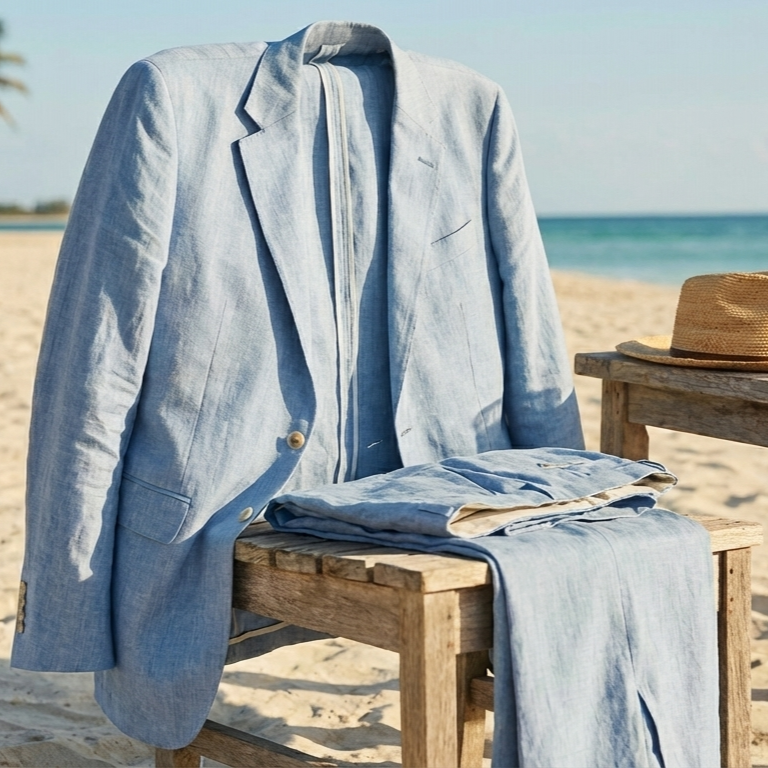
A linen summer suit is often the answer to the challenges of wearing tailoring in hot weather. Heat, humidity, and limited airflow can quickly make even a well-made suit feel uncomfortable outside air-conditioned spaces. While many suits only perform well indoors, linen stands apart as a fabric choice rooted in function, comfort, and long-established summer tailoring practice. Understanding why linen works in heat explains its lasting role in warm-weather dressing.
The Real Challenges of Wearing a Suit in Summer
Summer quickly exposes the weaknesses of many suits. What feels structured and comfortable in cooler conditions can become restrictive once heat, humidity, and movement come into play.
In hot weather, the body releases heat and moisture at a higher rate. When fabric cannot dissipate that heat efficiently, warmth and dampness become trapped between the body and the garment. Over time, this affects both comfort and appearance – jackets lose definition, trousers soften, and movement feels constrained.
Many traditional suit fabrics perform adequately in air-conditioned interiors but struggle outdoors. Even a well-cut suit can feel uncomfortable if the fabric is not aligned with the season, which is why material choice becomes as critical as tailoring in summer.
Read: Suit Fabrics Explained: How to Choose the Right Cloth by Occasion and Season
Linen Material – The Foundation of a Linen Summer Suit
A summer suit only performs as well as the fabric it is built on. Linen is often associated with warm-weather dressing not because of trends, but because its material properties are inherently suited to heat. Understanding linen as a textile, rather than a seasonal label, is key to understanding why the linen summer suit continues to be relevant.
What Is Linen? Origin, Structure, and Composition
To understand why linen works so effectively in hot weather, it is important to look at where it comes from and how the fiber itself behaves. Linen’s performance is rooted in its natural structure, not in modern finishing techniques.
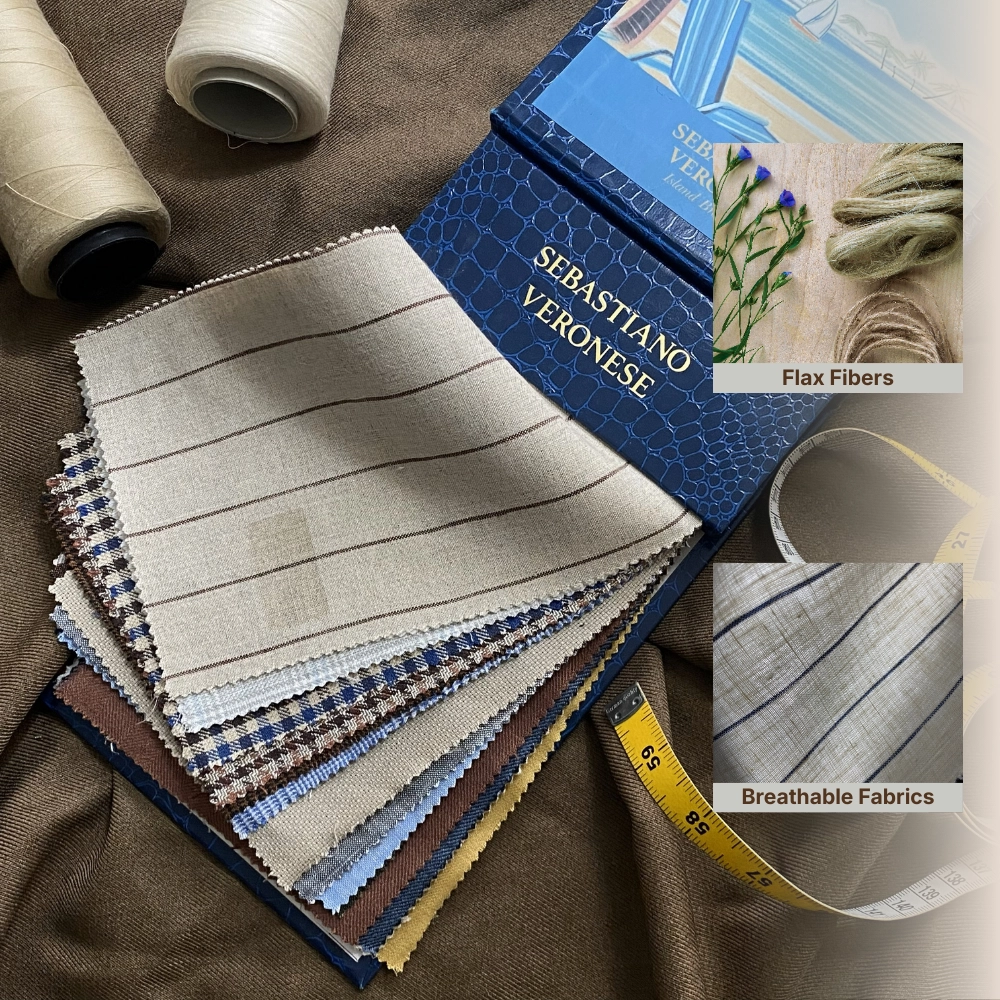
- A plant-based textile with a long history: Linen is made from flax fibers extracted from the stem of the flax plant. These fibers are among the longest natural fibers used in tailoring, allowing yarns to be spun with fewer joins. This creates a fabric that is inherently strong, stable, and well-suited to repeated wear in warm conditions.
- Cellulose composition and natural flammability: As a plant-derived fiber, linen is composed primarily of cellulose. This gives it a natural tendency to burn more readily than synthetic fibers, which melt rather than ignite. In professional fabric identification, this behavior is sometimes referenced as a basic authenticity indicator – true linen burns quickly and produces a scent similar to paper or dried leaves, unlike polyester or synthetic blends often used to imitate linen’s appearance.
- Distinct fiber behavior that defines comfort and appearance: Flax fibers have very low elasticity, giving linen its crisp hand feel and visible creasing. Their rigid structure also supports airflow, allowing heat to escape rather than remain trapped near the body.
- A surface texture that reduces skin contact in heat: Linen’s slightly irregular surface limits constant contact with the skin, helping prevent the fabric from clinging when exposed to moisture. This maintains small air gaps between the garment and the body, improving comfort in humid summer conditions.
Together, these characteristics explain why linen does not require synthetic blends or chemical treatments to perform well in summer. This natural behavior is what makes linen such a dependable foundation for a well-made linen suit intended for hot weather.
How Linen Regulates Heat Differently from Other Suit Fabrics
Linen’s cooling effect is not accidental. It manages heat in a fundamentally different way from many traditional suiting fabrics, which are designed to insulate rather than release warmth.
- Minimal heat retention at the fiber level: Linen fibers hold very little warmth close to the skin. Instead of storing heat within the fabric, linen allows it to dissipate quickly, helping the body maintain a more stable temperature during extended wear.
- A weave that promotes constant air movement: Even when tailored into jackets and trousers, linen maintains an open structure that supports airflow. This continuous circulation reduces the buildup of heat between layers, which is a common issue in more compact suit fabrics.
- Responsive comfort across changing environments: Linen adapts quickly as the wearer moves between air-conditioned interiors and outdoor heat. This responsiveness prevents sudden overheating, a problem often encountered with denser materials that adjust more slowly to temperature shifts.
- Effective performance beyond climate-controlled spaces: Unlike many suits that remain comfortable only in air-conditioned settings, linen continues to perform in natural, open-air environments. This makes it particularly suitable for summer wear where climate control is limited or inconsistent.
Because of this heat-regulating behavior, linen feels noticeably different on the body. Rather than forming a barrier, it works with the body’s natural cooling process. This is why a properly constructed bespoke linen suit can remain comfortable and composed in conditions where other suits struggle.
Why Linen Makes Sense for Summer Suits: Strengths and Trade-Offs
Linen is often praised for summer wear, but its value lies not in perfection – rather in a clear balance between performance and compromise that suits warm-weather tailoring.
The Practical Advantages of Linen in Summer Wear
Summer comfort is rarely the result of a single factor. With linen, comfort comes from how the fabric manages moisture, heat, and physical weight together, rather than excelling in only one area.
- Efficient moisture management: Linen absorbs perspiration quickly and releases it just as fast. Sweat is drawn away from the skin and evaporates rather than lingering in the fabric. This reduces dampness and surface friction, which is particularly important in humid environments where many suit fabrics begin to feel heavy and clingy.
- Low heat retention during extended wear: Linen does not store warmth close to the body. As movement and exposure increase throughout the day, heat is allowed to escape instead of accumulating between the fabric and the skin. This prevents the gradual buildup of discomfort and fatigue that often occurs when wearing a linen suit for long hours in summer conditions.
- Balanced fabric weight and wearing feel: Linen is available in a wide range of weights, from lightweight open weaves to more structured cloths suitable for tailoring. High-quality linen feels light on the body while remaining stable and substantial in hand. When chosen correctly, it provides visual presence without heaviness – an important balance for a bespoke linen suit intended for summer use.
Taken together, these qualities explain why a linen summer suit remains comfortable not only indoors, but across movement, time, and real summer exposure.
The Natural Limitations of Linen and Why They Are Acceptable
No fabric is without compromise, and linen is no exception. What matters is not the presence of limitations, but whether they are properly understood and managed. In linen, many perceived drawbacks are direct results of its natural fiber structure and can either be accepted or intelligently addressed through fabric choice.
- Wrinkling as an inherent behavior of pure linen fibers: Pure linen wrinkles easily because flax fibers have very low elasticity and limited recovery. Movement creates visible creases – particularly at stress points such as the elbows, waist, and seat – and these folds do not relax quickly. This is not a flaw in weaving or finishing, but a fundamental property of the fiber itself.
- Why blending linen can be a practical and acceptable solution: To reduce excessive wrinkling, many high-quality summer fabrics incorporate a small percentage of wool or silk. Wool improves elasticity and shape recovery, while silk enhances smoothness and drape. These blends help maintain appearance over time and reduce surface fuzzing that can occur with repeated wear and washing of pure linen without compromising breathability.
- Surface irregularities as “the beauty of natural”: Linen is made from natural flax fibers that vary in length and thickness. During spinning, this variation can create small slubs or neps – appearing as subtle dots or raised textures in the finished fabric. The purer the linen, the more visible these characteristics tend to be. Rather than indicating poor quality, they reflect minimal processing and are widely valued as signs of authenticity.
Acknowledging these characteristics honestly strengthens the case for linen. Whether chosen in pure form or blended thoughtfully, linen’s imperfections are not defects to be corrected, but natural expressions of the material itself – defining the character and appeal of a linen summer suit.

Linen Summer Suits in Bespoke Tailoring
A linen summer suit reveals the quality of tailoring more quickly than almost any other garment. Because linen is honest in its behavior, it leaves little room for shortcuts or imprecision.
- Proper fabric preparation and cutting precision are non-negotiable: Linen is prone to shrinkage if it has not been stabilized before cutting, which is why a professional bespoke tailor shop will pre-treat the cloth through controlled washing, steaming, or resting to allow the fibers to settle. At the same time, linen’s low elasticity means it does not forgive inaccuracies in pattern or fit.
- Construction choices directly affect comfort and longevity: For linen, construction is best kept light – often half canvas with minimal lining, or combined with quarter-lined or unlined jackets. Overbuilding a linen summer suit can negate its cooling advantages, while under-structuring can lead to premature collapse. Experienced tailoring balances breathability with enough internal support to maintain shape over time.
- The advisory role of the tailor is part of the garment itself: A responsible bespoke tailor shop does more than cut and sew. Guidance on how to wear linen – when to embrace creasing, how to rotate garments, and how to store them helps the wearer maintain both appearance and comfort. Care advice, including pressing methods and cleaning intervals, plays a crucial role in preserving the integrity of a linen suit.
When selecting a linen summer suit, decisions should be based on function rather than assumption, especially in a bespoke context. Lighter linens suit high heat and relaxed settings, while mid-weight linens provide better structure for regular wear. Light or neutral colors remain the most practical in summer. These choices are most effective when guided by a bespoke tailor shop experienced with linen.
Conclusion: A Linen Summer Suit Is Not a Trend, but a Thoughtful Choice
Linen has held its place in summer tailoring long before seasonal trends came and went. Its relevance comes from function, not fashion – how the fabric responds to heat, moisture, and movement in real conditions. When linen is properly understood, selected with intention, and executed through skilled tailoring, a linen summer suit remains a reliable and practical choice for warm weather. It is not about chasing an aesthetic, but about choosing a material that works honestly with the environment it is worn in.
You can explore suitable linen options for the coming summer in the Rosie Hong Fabric Collection.
DISCOVER PHYIGITAL BESPOKE TAILORING