The Ultimate Guide to Black Tie: Mastering the Bespoke Tuxedo
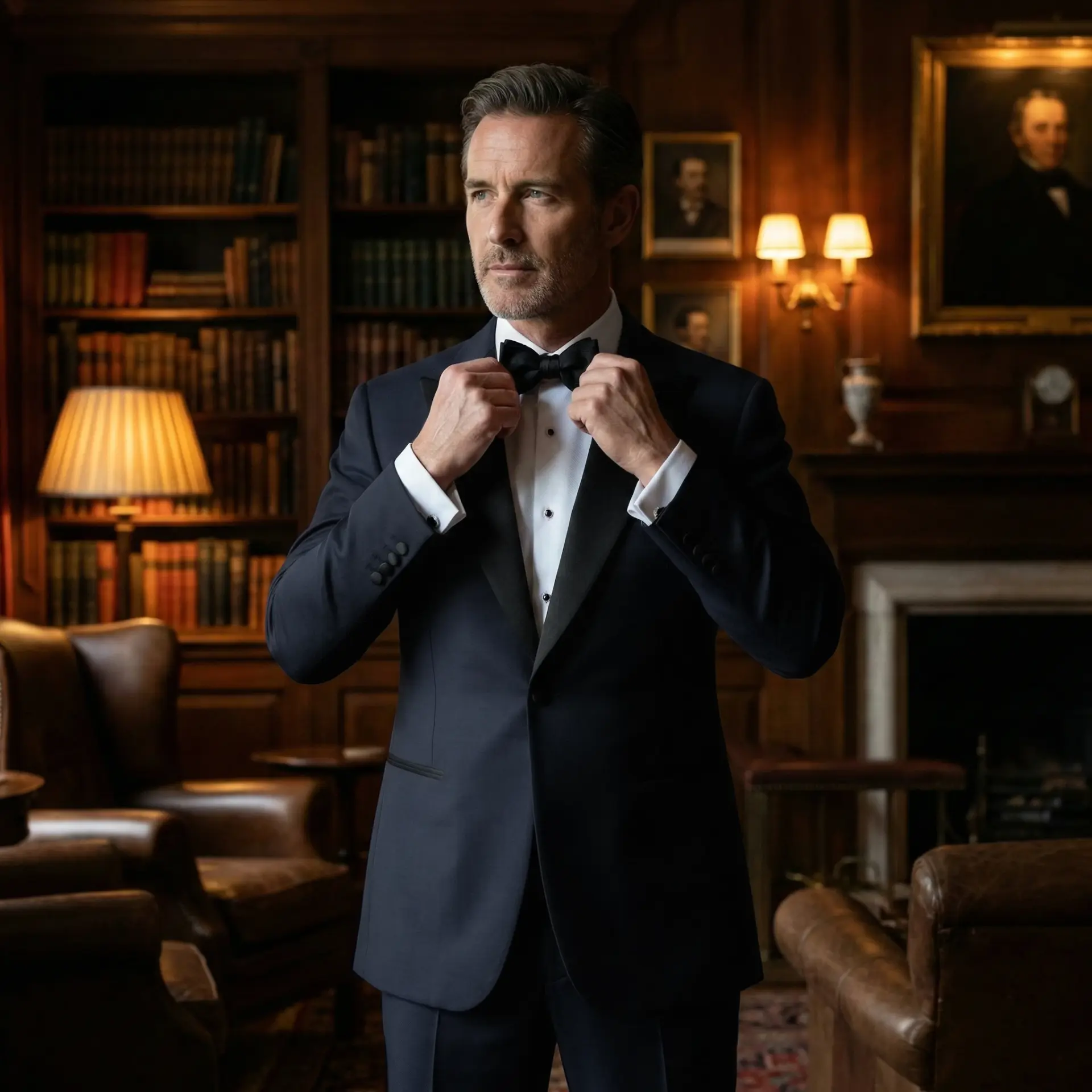
Black Tie is the gold standard of men’s evening wear, representing not just a set of rules, but a gesture of respect to the occasion. However, true elegance lies in the details that mass-produced garments simply cannot replicate. This bespoke tuxedo guide is designed to walk you through the essential nuances of formal tailoring – from the history of the dinner jacket to the technical anatomy of lapels and fabrics, ensuring your commission results in a garment of timeless distinction. This guide serves as the foundation of our Black Tie series. For modern interpretations, seasonal considerations, and specialized occasions, you’ll find deeper explorations throughout our related guides.
The Philosophy & History: More Than Just a Suit
To master the tuxedo, one must first understand its purpose. Unlike business attire, which signals hierarchy and profession, Black Tie is traditionally democratic. It is a uniform of elegance intended to place all men on an equal footing, allowing their personalities and the quality of their tailoring to speak louder than loud patterns or trends.
The Philosophy: The Art of Subtlety
The guiding principle of Black Tie is respect – respect for the host, the occasion, and the company one keeps. The strict black-and-white palette is designed to minimize visual noise. By removing the distraction of colors, the focus shifts entirely to the wearer’s face and the garment’s silhouette. However, knowing how to navigate the nuances of the event is equally important. Read our guide on Black Tie Etiquette
This is why bespoke tailoring is critical in Black Tie. In a sea of identical black suits, the only way to distinguish oneself is through superior fit, the drape of the canvas, and the texture of the fabric. The tuxedo does not shout; it whispers quality.
A Brief History: Savile Row to Tuxedo Park
The garment we know today was born from a desire for comfort without sacrificing elegance.
- The British Origin (1865): The story began on Savile Row. The Prince of Wales (later King Edward VII) commissioned his tailors, Henry Poole & Co, to create a short evening coat in midnight blue to be worn at informal dinners at Sandringham. He essentially requested a tailcoat with the tails cut off – resulting in the first “Dinner Jacket.” Crucially, it retained the silk lapels of its predecessor, the Smoking Jacket. Originally functional, designed to allow cigar ash to slide off easily – this silk facing remains the defining characteristic that separates a tuxedo from a mere black suit.
- The American Adoption (1886): The style crossed the Atlantic when American millionaire James Brown Potter visited the Prince, admired the jacket, and ordered a similar one from Henry Poole. When Potter returned to New York, he wore the jacket to the exclusive Tuxedo Park Club. The members were so intrigued by the “jacket worn at Tuxedo” that the name stuck.
Thus, while the British retained the term Dinner Jacket (or Le Smoking in France), the Americans popularized the term Tuxedo. Regardless of the name, the lineage remains rooted in the highest standards of bespoke craftsmanship.
The Anatomy of a Perfect Tuxedo (Technical Deep Dive)
While the philosophy of Black Tie is rooted in respect, its execution is a matter of architectural precision. A mass-produced tuxedo is merely a black suit with shiny lapels. A bespoke tuxedo, however, is designed with specific proportions to elongate the body, broaden the shoulders, and create an unbroken line of elegance.
To master the look, one must understand the technical rules that govern the jacket and trousers.
The Dinner Jacket: Silhouette & Construction
The jacket is the command center of the outfit. Its primary goal is to frame the shirt bib and the wearer’s face while creating a “V” shape torso.
1. The Lapels: The Signature of Formalwear The lapel is the most distinguishing feature of a dinner jacket. Unlike business suits, tuxedo lapels are “faced” (covered) in silk to contrast with the matte wool of the body.
- The Peak Lapel: The most traditional and authoritative choice. In bespoke tailoring, we ensure the “peaks” extend past the collar seam, pointing towards the shoulders. This emphasizes shoulder width and height dominance. It is the gold standard for formal elegance.
- The Shawl Collar: A continuous, smooth curve that originated from the Victorian smoking jacket. It offers a softer, more relaxed aesthetic. A bespoke shawl collar should have a perfect “belly” (curve) that rolls naturally down to the buttoning point.
Not sure which profile suits your physique? Read our guide: [Peak vs. Shawl Lapel: Choosing the Right Profile for Your Physique]
Note:
- The “Notch” Prohibition: NEVER choose a notch lapel for a tuxedo. Notch lapels are designed for “step-down” formality (business suits and sport coats). Wearing one to a Black Tie event breaks the upward sweep of the jacket’s lines and suggests a lack of sartorial knowledge.
- Bespoke Detail – The Boutonnière: A true bespoke jacket will feature a functional flower loop on the left lapel. For the ultimate sign of craftsmanship, request a Milanese Buttonhole – a raised, hand-stitched silk loop that sits atop the lapel silk, rather than being cut into it.
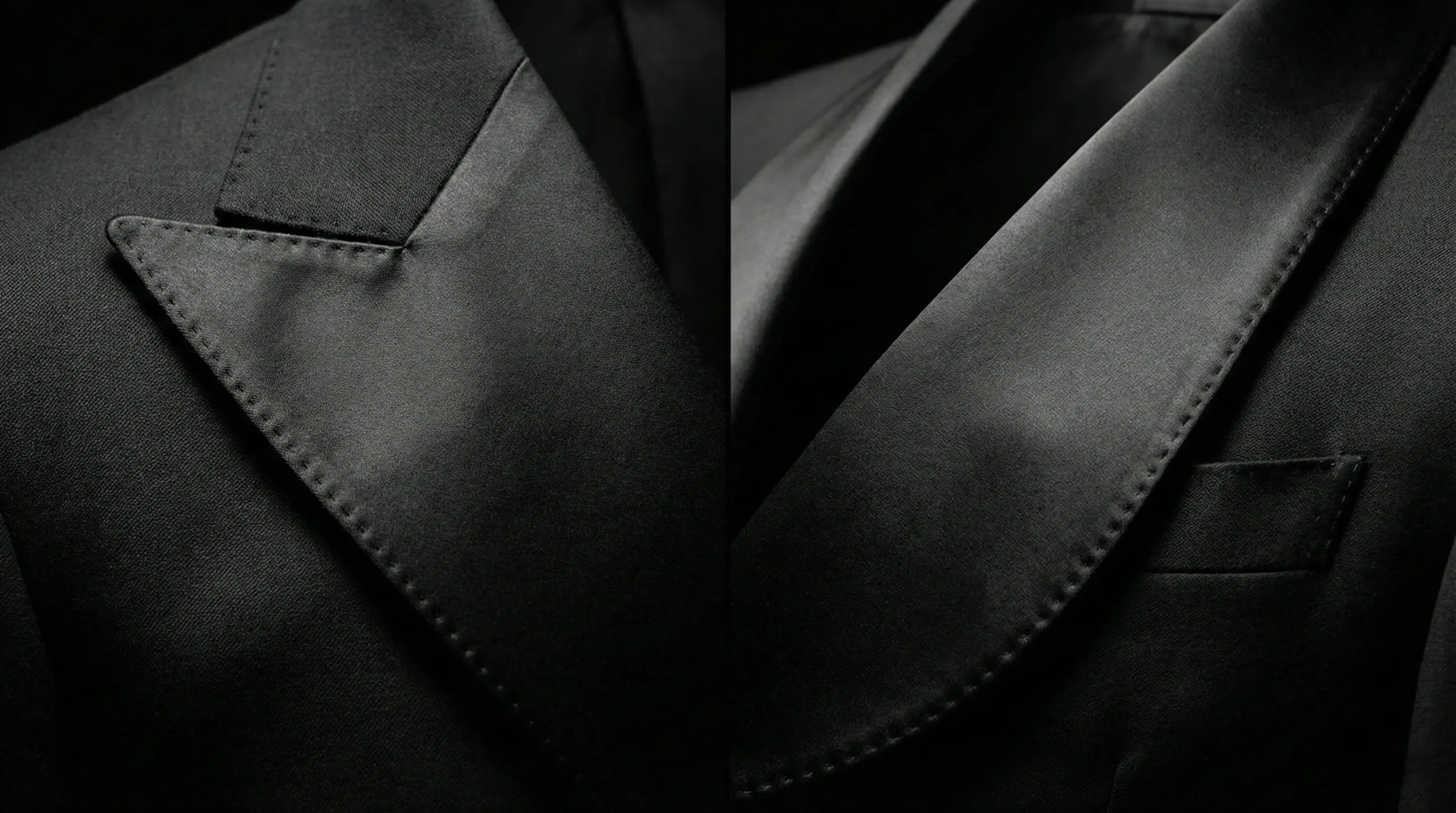
2. The Facings: Texture & Harmony The silk covering the lapels dictates the tone of the entire outfit.
- Satin Silk: Smooth, high-gloss, and reflective. It pops under evening lights and offers a glamorous, high-contrast look.
- Grosgrain Silk: A ribbed, matte silk with a subtle texture. It is understated, vintage-inspired, and often preferred by connoisseurs for its refined, non-shiny finish.
- The Golden Rule: Whatever silk you choose for your lapels must be perfectly matched on your bow tie, cummerbund, and trouser braid.
3. The Fastening: The “One Button” Rule
- Single-Breasted: A single-breasted dinner jacket must have only one button. Placing two buttons on a tuxedo is a common error in ready-to-wear fashion. The single button is positioned at the natural waist (the narrowest part of the torso) to cinch the jacket and create a longer leg line.
- Double-Breasted: A sophisticated alternative, typically in a 2×1 or 4×1 or 6×1 or 6×2 configuration. Because a double-breasted jacket stays buttoned even when sitting, it eliminates the need for a waist covering (cummerbund or waistcoat), offering a cleaner, more armored look.
4. The Pockets & Vents: Minimizing Clutter
- Jetted Pockets (Besom Pockets): Tuxedo pockets should be thin slits piped in the same silk as the lapels. Flaps are discouraged because they add bulk at the hip; if your jacket has them, they must be tucked in.
Ventilation:
- No Vents: Historically, dinner jackets had no vents to preserve a statue-like silhouette.
- Double Vents: Acceptable in modern bespoke tailoring for comfort and easier pocket access.
- Single Vent: Strictly FORBIDDEN. It exposes the seat of the trousers when you move and destroys the garment’s clean lines.
The Trousers: The Foundation of the Look
If the jacket is the star, the trousers are the supporting act that makes the performance possible. They must provide a seamless transition from the waist down.
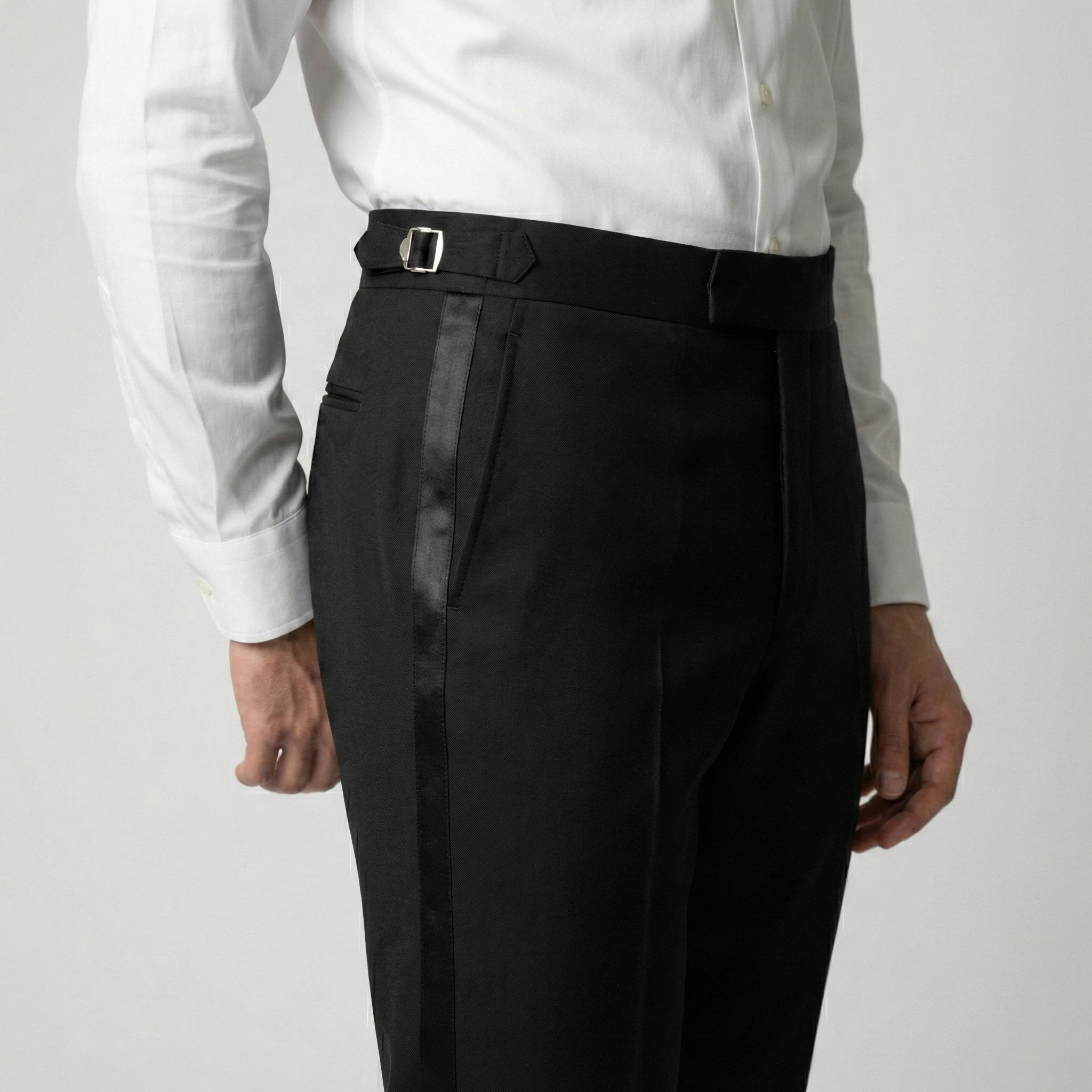
1. The High Rise: Bespoke tuxedo trousers are cut with a high rise, sitting at the natural waist (near the navel), not on the hips. This is critical for one reason: it ensures that when the jacket is buttoned, no white shirt fabric is visible between the waistband and the jacket button. The shirt must remain a pristine “triangle” on the chest, not peeking out at the waist.
2. The Galon (Side Braid): A single stripe of silk running down the outer seam of each leg is mandatory. This is called the galon. It covers the structural seam of the trousers and provides a vertical line that visually lengthens the leg. The width of the galon can be adjusted in bespoke tailoring – wider for a vintage look, narrower for a modern silhouette.
3. Waist Suspension: No Belts Allowed
A belt adds horizontal bulk and breaks the vertical flow. Therefore, tuxedo trousers never have belt loops. Instead, they are supported by:
- Side Adjusters: Buckles or tabs on the waistband to cinch the fit.
- Braces (Suspenders): Buttons are sewn inside the waistband to attach silk braces. This allows the trousers to “hang” perfectly straight, maintaining a sharp crease.
4. The Hem: Plain and Precise
Tuxedo trousers must have plain hems. Cuffs (turn-ups) are a casual detail derived from protecting trousers from mud in the country, they have no place indoors at a formal event. The trousers should be hemmed with a minimal break (just touching the shoe laces) to maintain a razor-sharp profile.
Fabric Selection: The Foundation of Bespoke
In bespoke tailoring, fabric is not merely a material; it is the medium through which the tailor sculpts the silhouette. When commissioning a bespoke dinner jacket, the choice of cloth is critical because it determines how the garment behaves under artificial evening light.
While a business suit must perform in daylight, a tuxedo must command the room after sunset. Therefore, the texture, weave, and “blackness” of the fabric are the primary considerations.
The Material Hierarchy: Wool, Mohair, and Velvet
1. Barathea Wool: The British Classic Barathea is the gold standard for traditional black tie. It is a soft fabric with a broken-rib weave that gives it a slightly pebbled texture.
- The Look: It has a matte finish that absorbs light rather than reflecting it. This creates a deep, saturated look that photographs exceptionally well.
- The Feel: Soft, draping elegantly over the body’s contours.
- Best For: Traditionalists seeking a versatile, timeless aesthetic.
2. Mohair Blends: The Sharp & Lustrous Choice Mohair (fiber from the Angora goat) is often blended with wool to create a fabric with distinct characteristics, highly favored in modern bespoke tailoring.
- The Look: Unlike Barathea, Mohair has a natural sheen (luster). Under evening lights, it offers a subtle, sophisticated glow that distinguishes a bespoke dinner jacket from ordinary matte suits.
- The Performance: Mohair is incredibly resilient. It resists wrinkling and holds a “sharp” crease better than any other fiber, ensuring you look as crisp at the end of the party as you did at the beginning.
- Best For: Hot climates (due to its breathability) or men who prefer a sharper, more structured armor-like silhouette. If you are planning attire specifically for a destination wedding or coastal event, discover how to master the [Tropical Black Tie: Hosting an Elegant Evening in Humid Climates]
3. Velvet: The Host’s Privilege Velvet is typically reserved for the Smoking Jacket, a variation of the dinner jacket often worn by the host of a party or for home entertaining.
- The Vibe: Luxurious, tactile, and rich. Velvet absorbs light intensely, creating colors of incredible depth (Deep Burgundy, Bottle Green, or Navy).
- Best For: “Creative Black Tie” or holiday parties. Note: Velvet jackets are usually paired with tartan or standard black tuxedo trousers, never velvet trousers.
Discover how to style this luxurious piece in our article: [Beyond Black: The Resurgence of the Velvet Dinner Jacket].
The Great Debate: Midnight Blue vs. Black
While black is the obvious choice, sartorial connoisseurs often opt for something subtler.
The “Blacker Than Black” Principle In the 1920s, the Duke of Windsor (a global style icon) popularized the use of Midnight Blue wool for evening wear.
- The Science: Under the artificial yellow/orange glow of chandeliers and incandescent bulbs, pure black wool can sometimes appear dull or cast a greenish/grayish tint.
- The Solution: Midnight Blue is an extremely dark shade of navy. Under artificial light, the blue pigment absorbs the yellow light, making the fabric appear a richer, deeper black than black itself.
- The Verdict: If you want absolute tradition, choose Black. If you want the garment to look its best in photographs and ballrooms, choose Midnight Blue.
Completing the Look: Accessories & Footwear
A bespoke tuxedo is defined not just by the fit of the jacket and trousers, but by the harmony of the elements that accompany it. In Black Tie, accessories are not mere “extras”; they are structural components of the dress code. Each piece serves a specific function in maintaining the polished aesthetic of your bespoke tuxedo.
The Formal Shirt: The Canvas
The shirt provides the crisp white backdrop that contrasts with the black jacket. It must always have double cuffs (French cuffs) for cufflinks.
The Front (Bib):
- Marcella (Piqué): The most modern and rigid option. It features a stiff, waffle-textured front. It stays crisp all night, complementing the sharp lines of a bespoke tuxedo.
- Pleated: The classic choice with vertical pleats running down the front. It is softer and slightly more traditional.
The Collar:
- Turn-down Collar: The standard and safest choice. It frames the bow tie perfectly.
- Wing Collar: Traditionally reserved for White Tie. While some wear it with Black Tie, it can risk looking like a waiter’s uniform. For a modern bespoke tuxedo, the turn-down collar is generally preferred.
Hardware (Studs & Cufflinks):
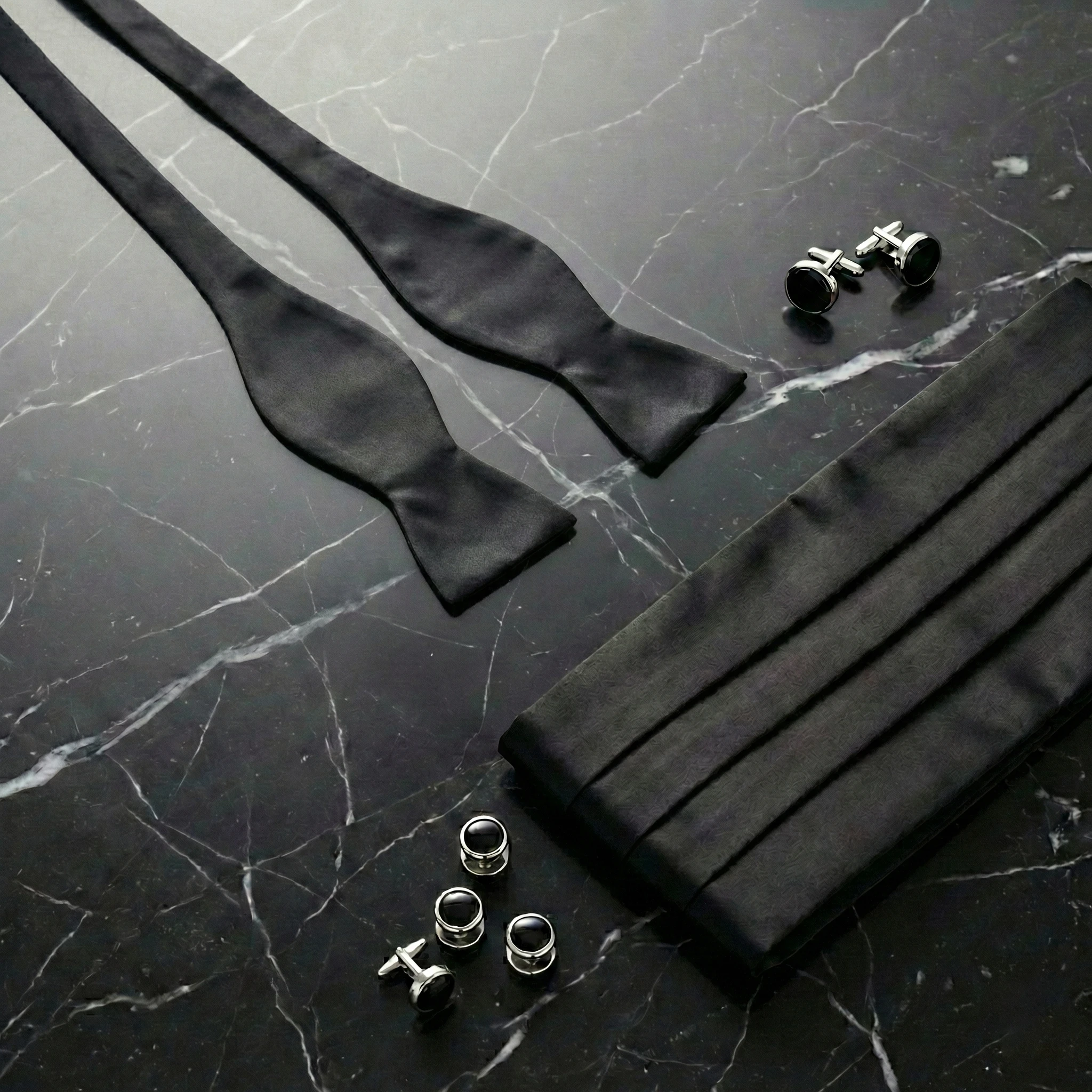
- A formal shirt does not show buttons. Instead, the placket is fastened with studs. Studs and cufflinks should match (usually black onyx or mother-of-pearl).
The Waist Covering: The Golden Rule
The most critical rule of bespoke tuxedo anatomy is: The waistband of the trousers must never be visible. To achieve the illusion of longer legs, the transition between the trousers and shirt must be seamless.
The Cummerbund:
- A pleated sash worn around the waist.
- The Rule: The pleats must always face up (historically used to hold opera tickets). Ideally suited for warm climates or shawl collar jackets.
- Unlike a business vest, a tuxedo waistcoat must be “low-cut” (deep U-shape or V-shape). It should barely be visible when the jacket is buttoned.
- Warning: Never wear a high-cut business waistcoat; it destroys the vertical line of the shirt bib.
- Exception: If you wear a Double-Breasted jacket, you do not need a waist covering.
The Bow Tie: The Soul of the Outfit
The bow tie is the focal point of your face.
Self-Tie vs. Pre-Tied:
- You must wear a self-tie bow tie. A pre-tied bow tie is flat and lifeless, a tell-tale sign of a rental. A self-tied knot has dimension and a slight asymmetry that signals the elegance of a true gentleman.
Fabric Matching:
- The material of the bow tie must match the facing of your jacket lapels.
- Satin Lapels = Satin Bow Tie.
- Grosgrain Lapels = Grosgrain Bow Tie.
Black Tie Footwear: Anchoring the Look
Your shoes should be as streamlined as your suit. Chunky soles or broguing are strictly forbidden.
- Patent Leather Oxfords: The most popular choice. The high-gloss shine complements the satin lapels. The style must be a Plain Toe or a Wholecut.
- Opera Pumps (Court Shoes): The most formal option. Patent leather slip-ons with a silk bow, the ultimate sign of a connoisseur.
- Velvet Slippers (Albert Slippers): Acceptable for “Creative Black Tie” or when hosting at home, adding a touch of personality.
When every accessory is chosen with intention, the tuxedo becomes a single, uninterrupted composition rather than a collection of parts.
Why Choose a Bespoke Tuxedo?
Buying a tuxedo off the rack is a transaction; commissioning one is an investment in yourself. While ready-to-wear garments can be convenient, they simply cannot replicate the precision and longevity of a garment made specifically for you.
- The Fit:
Sculpting the Ideal Silhouette: Unlike off-the-rack garments designed for a symmetrical, standardized mannequin, a bespoke tuxedo is drafted from scratch to map your unique topography. A master cutter takes into account nuances that mass manufacturing ignores, such as sloping shoulders, a dropped shoulder, or a forward-leaning posture. By adjusting the pattern to accommodate these physical realities, the tailor disguises imperfections and enhances your best features, creating a silhouette that looks effortless and feels weightless.
- The Construction:
The Hidden Luxury: True quality lies beneath the surface. While mass-produced formalwear often relies on stiff fusible interlining (glue) to hold its shape, a bespoke dinner jacket is built using traditional full-canvas construction. This internal layer of horsehair and wool canvas floats between the fabric and lining, allowing the bespoke jacket to “breathe” and drape naturally. Over time, this canvas molds to your body’s heat and shape, ensuring the garment not only lasts a lifetime but actually improves with wear.
- The Experience:
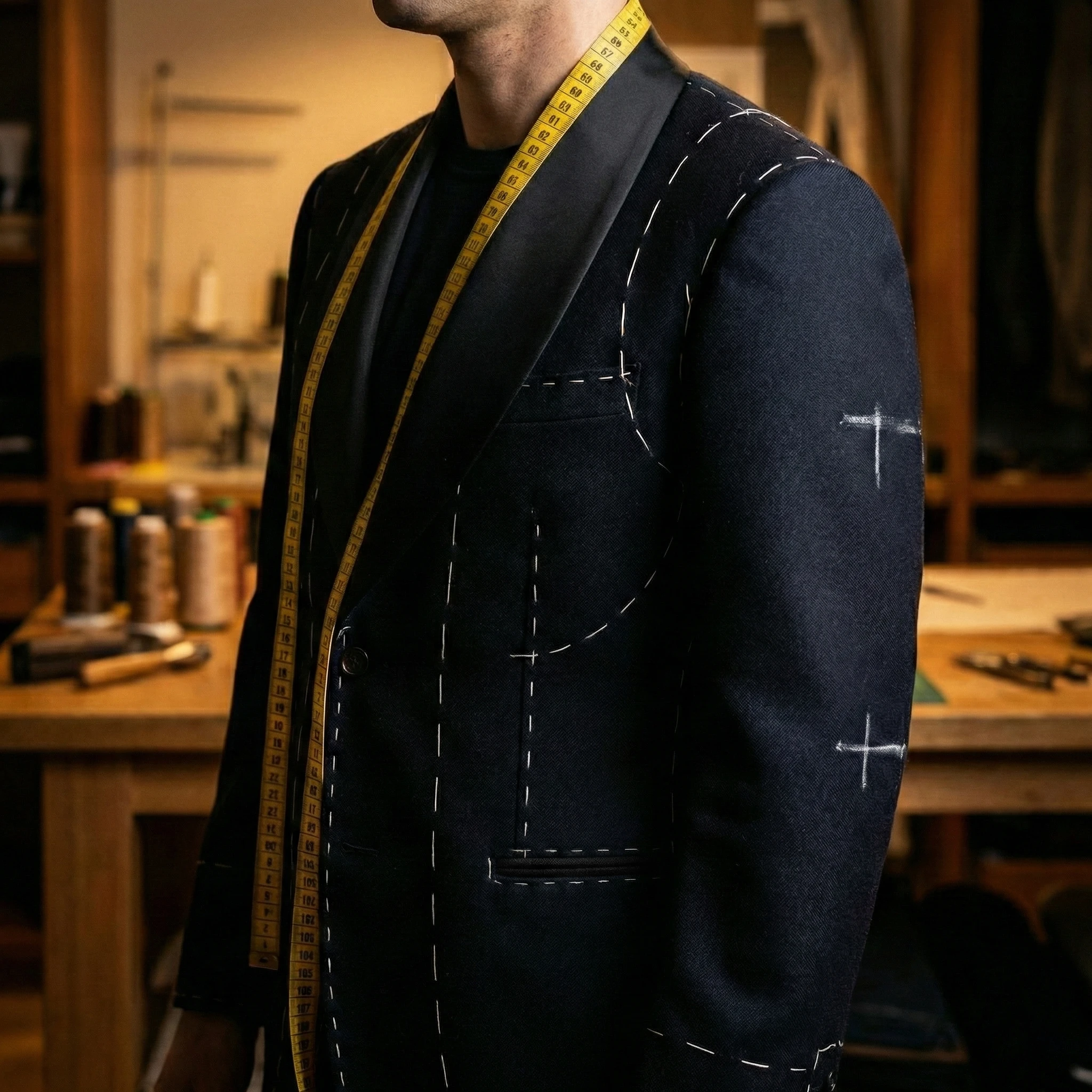
A Collaborative Journey: The bespoke process is not merely about purchasing clothing; it is a collaborative journey between client and artisan. It begins with a comprehensive consultation and precise measurements, followed by the “basted fitting” – a stage where the garment is tried on in a raw, deconstructed state held together by temporary white basting threads. This crucial step allows the tailor to refine every millimeter of the fit, from the sleeve pitch to the precise drop of your tuxedo waistcoat, ensuring the final result is nothing short of perfection.
Conclusion
Ultimately, Black Tie is not about blending in; it is about standing out through the quiet perfection of your attire. A bespoke tuxedo is more than a garment – it is a personal investment that instills confidence, ensuring you are impeccably prepared for life’s most significant moments. If you are preparing for your big day, explore [The Groom’s Black Tie Handbook].
Whether you opt for the classic midnight blue wool or a velvet dinner jacket, the true mark of elegance lies in the fit that only a master tailor can provide. We invite you to book a consultation or explore our collection online to experience the fabric, discuss your preferences, and begin the journey of crafting a tuxedo tailored uniquely to you.
DISCOVER PHYIGITAL BESPOKE TAILORING