The 12-Hour Deposition Suit: Why High-Twist Wool is a Lawyer’s Best Investment

In the polished world of high-stakes litigation, the true value of a deposition suit is not measured at 8:00 AM, but at the 12th hour. While looking sharp in the morning is the bare minimum, the real challenge for a litigator’s wardrobe is finishing the day as composed as it started.
Whether you are navigating a marathon deposition or stepping off a red-eye flight for a client meeting, your bespoke suit must remain as unshakeable as your legal arguments. For the modern attorney, a suit is not just ceremonial attire; it is performance gear. Think of it this way: High-Twist wool is the “Activewear” of the corporate world, a material engineered for endurance, movement, and resilience.
This is why it is not a luxury; it is a strategic necessity.
The Problem: The “Accordion Effect” in a 12-Hour Day
Litigation is an endurance sport, yet most business suits are designed for a sprint.
The Reality of the War Room
Consider the standard scenario: You are seated in a climate-controlled conference room for a deposition. The hours drag on. You are shifting in a leather chair, crossing and uncrossing your legs, leaning on your elbows while reviewing exhibits.
- Heat & Pressure: Your body heat and the pressure against the chair create a “steaming effect” on the fabric.
- The Culprit: Fine Super 150s or luxurious Silk-wool blends, while incredibly soft to the touch, simply collapse under this stress. They lack the natural memory required to spring back into shape.
The Visual Cost
When you finally stand up to make an objection or shake hands at the end of the session, the damage is visible.
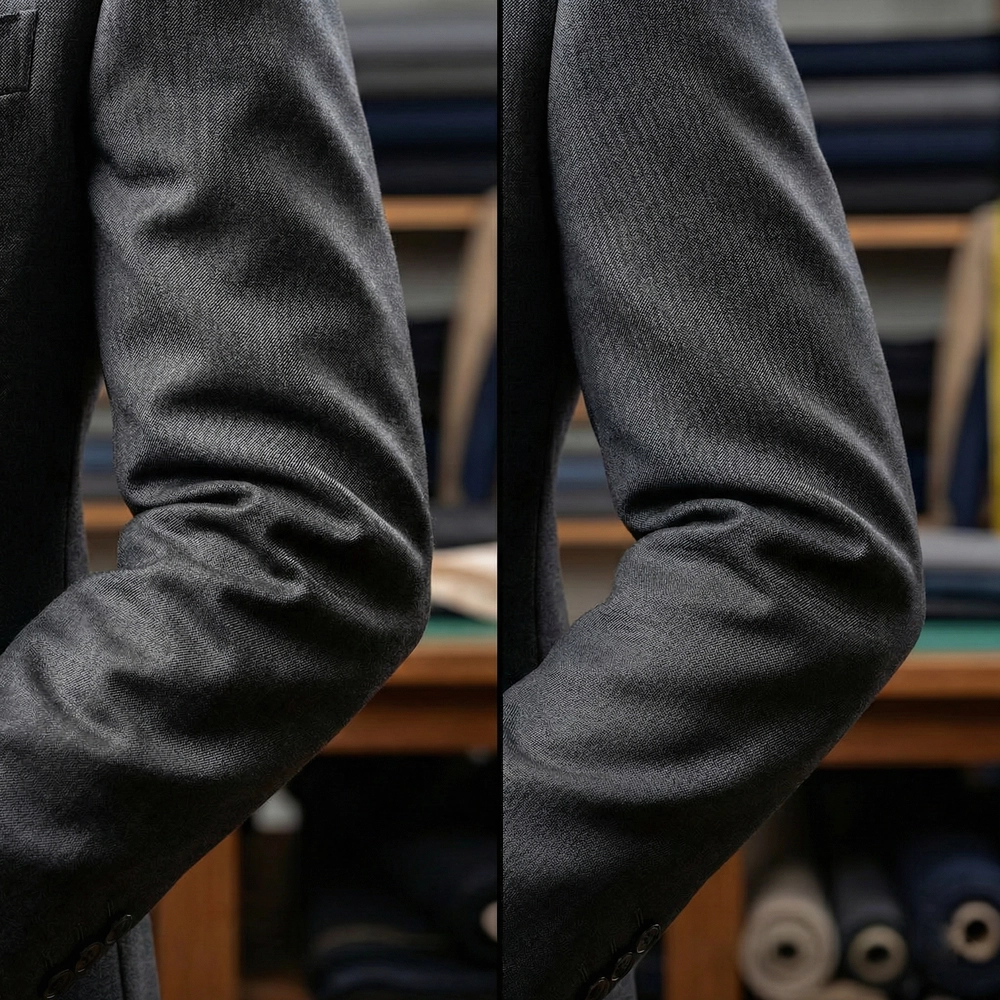
- The “Accordion Effect”: Deep, unsightly wrinkles have formed behind your knees and inside your elbows. The jacket skirt is crushed, and the trousers have lost their sharp crease.
- The Perception: Instead of looking like a commanding authority, you look “defeated” by the process. In the eyes of opposing counsel or a client, a disheveled travel suit for lawyers signals fatigue and a loss of control.
To maintain your edge, you need a fabric engineered to fight back against gravity and heat. You need High-Twist.
The Solution: High-Twist Wool – The Physics of Resilience
The secret to a pristine Deposition Suit does not lie in synthetic blends or chemical coatings. It lies in the physics of the yarn itself.
The Engineering: It’s in the Spin
Many clients mistake “High-Twist” for a specific fabric composition. In reality, it is an advanced spinning technique.
The Spring Analogy: Imagine a standard wool fiber as a relaxed piece of string. Now, imagine twisting that string tightly until it coils upon itself. That is High-Twist. By spinning the yarn with extra revolutions per inch, weavers create a microscopic “spring” loaded with potential energy.
The Hand-Feel: Business, Not Leisure
Because of this tight twist, the fabric behaves differently than what you might be used to.
- The “Dry” Hand: While High-Twist lacks the buttery softness of flimsy Super 150s, it possesses a crisp, dry hand that signifies “Business”, rather than “Leisure”.
- The Parchment Effect: It feels like a fresh sheet of crisp parchment, ready for the signature on a settlement agreement. This “dryness” is intentional; it prevents the fabric from clinging to your legs, allowing the bespoke trousers to hang cleanly even in humid conditions.
The Benefits: Memory & Breathability
- Natural Memory (The “Bounce Back”): When you sit for hours, you compress the fabric. Standard fibers break or bend flat, but High-Twist fibers resist this compression. The moment you stand up, the tension in the yarn releases, snapping the fabric back to its original shape.
- The Open Weave: The strength of the yarn allows for a porous, “open” weave. Hold a swatch up to the light, and you will see tiny pinholes. This allows air to circulate freely, keeping you cool in the “hot seat” of a negotiation.
The Gold Standard: Choosing Your Armor (Holland & Sherry vs. Dormeuil)
Not all High-Twist fabrics are created equal. For the demanding schedule of a litigator, we recommend two distinct paths:
The “Iron Man”: Holland & Sherry Crispaire
For the road warrior who prioritizes absolute durability.
- The Profile: Holland & Sherry Crispaire is legendary for being virtually indestructible. It is a heavier cloth with a very dry, crisp finish.
- The Verdict: It holds a trouser crease like a knife edge, ensuring that even after a 6-hour flight, you walk into the client meeting looking like you just stepped out of the tailor’s fitting room.
The “Negotiator”: Dormeuil Excel
For the attorney who needs comfort without sacrificing elegance.
- The Profile: Utilizing French weaving technology, Dormeuil Excel incorporates a natural stretch (up to 20%) purely through the weaving process, without using Lycra.
- The Verdict: If your day involves dynamic movement, such as pacing the courtroom or leaning over conference tables, this fabric moves with you, offering a level of comfort that traditional High-Twist cannot match.

The Internal Engine: Canvas Construction vs. Fused (The Hidden Culprit)
Investing in High-Twist wool but settling for a fused (glued) construction is like putting a Ferrari engine inside a cardboard chassis. The performance of the fabric is rendered useless if the “engine” inside cannot handle the heat.
The Villain: Fused Construction (The “Plastic Bag” Effect)
Most commercial suits, even expensive designer labels, use a “fused” construction. This means a layer of synthetic interlining is glued directly to the back of the wool fabric.
- The Sauna Trap: Glue does not breathe. In the high-stress environment of a deposition, as your body temperature rises, a fused suit acts like a plastic bag, trapping heat and moisture against your shirt.
- The Bubbling Risk: Over time, the heat from your body and the chemicals from dry cleaning cause the glue to degrade. The result is “bubbling”: unsightly ripples on the lapels and chest that make a suit look cheap and neglected.
The Hero: Canvas Construction (The Breathing Layer)
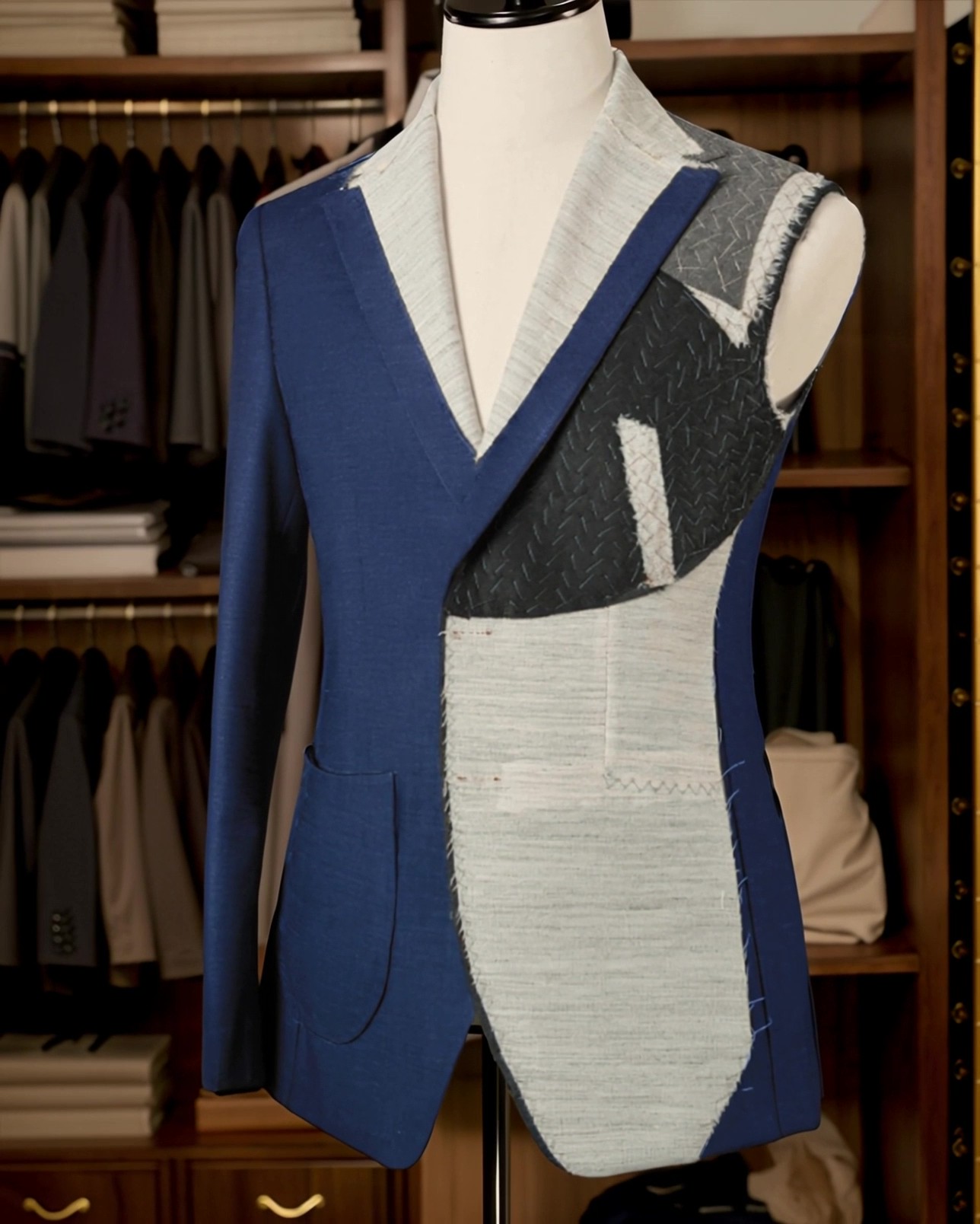
For a Deposition Suit, the internal architecture must be as resilient as the exterior. This is where Canvas Construction (Half or Full) becomes non-negotiable.
- The Floating Interface: Instead of glue, we use a layer of natural horsehair canvas that is stitched to the wool, allowing it to “float.”
- The Airflow Synergy: Remember the “open weave” of the High-Twist wool we discussed? Canvas construction respects that openness. It allows air to pass through both the wool and the canvas, keeping you cool and composed when the questioning gets heated.
The Comfort Factor: Drapery in Motion
A lawyer is rarely static. You lean forward to emphasize a point; you turn to consult your client.
- Fused: A glued suit is stiff. It fights against your movement, creating tension across the shoulders.
- Canvas: Horsehair canvas is alive. It warms up with your body heat and molds to your shape. It moves with you, not against you.
- The “Second Skin”: With a Full-Canvas suit, this floating layer extends all the way to the hem, ensuring that after 12 hours, the jacket feels like a second skin, whereas a fused suit feels like a rigid cage.
Conclusion: Endurance is Part of Excellence
In the courtroom, as in life, how you finish is just as important as how you start. A litigator’s credibility is built on stamina: the ability to remain sharp, focused, and commanding when everyone else is exhausted.
A Deposition Suit crafted from High-Twist wool is more than just a garment; it is a strategic asset. It ensures that at the 12th hour of a negotiation, while others look disheveled and worn down, you remain visually pristine. That subtle difference, seen in the crispness of your lapel and the sharp line of your bespoke trousers, sends a powerful, subconscious signal: You are still in control.
However, resilient fabric is only one layer of your defense. To truly command the room, every element, from the canvas construction to the silhouette, must be perfectly engineered.
To master the complete architecture behind a winning wardrobe, refer to our comprehensive blueprint: [The Attorney’s Armor: The Ultimate Guide to Bespoke Suits for Modern Lawyers].
DISCOVER PHYIGITAL BESPOKE TAILORING