Androgynous Wedding Suit Colors: Why Ivory, Jewel Tones & Jacquards Rule
Black is the safe harbor of formalwear. But for the LGBTQ+ community, a wedding is about rewriting the script. Choosing androgynous wedding suit colors is more than just an aesthetic preference; it is a declaration of visibility.
The hesitation often lies in the fear of looking “costumey” rather than elegant. However, true formality isn’t defined by tradition, but by execution. With the right fabric, a sophisticated palette, and the precision of a Bespoke tuxedo, you can command the room in a look that is vibrant, structured, and authentically yours. Whether you are envisioning a bold Emerald green tuxedo suit or a subtle ivory look, the key lies in the tailoring.
The New “Bridal White”: Mastering the Ivory Dinner Jacket
For many in the community, wearing white signifies a connection to the celebratory nature of a wedding, even if the silhouette of a gown feels foreign. The solution lies not in a monochromatic white suit, which can often look flat or overly theatrical but in the sophisticated contrast of Tropical Black Tie.
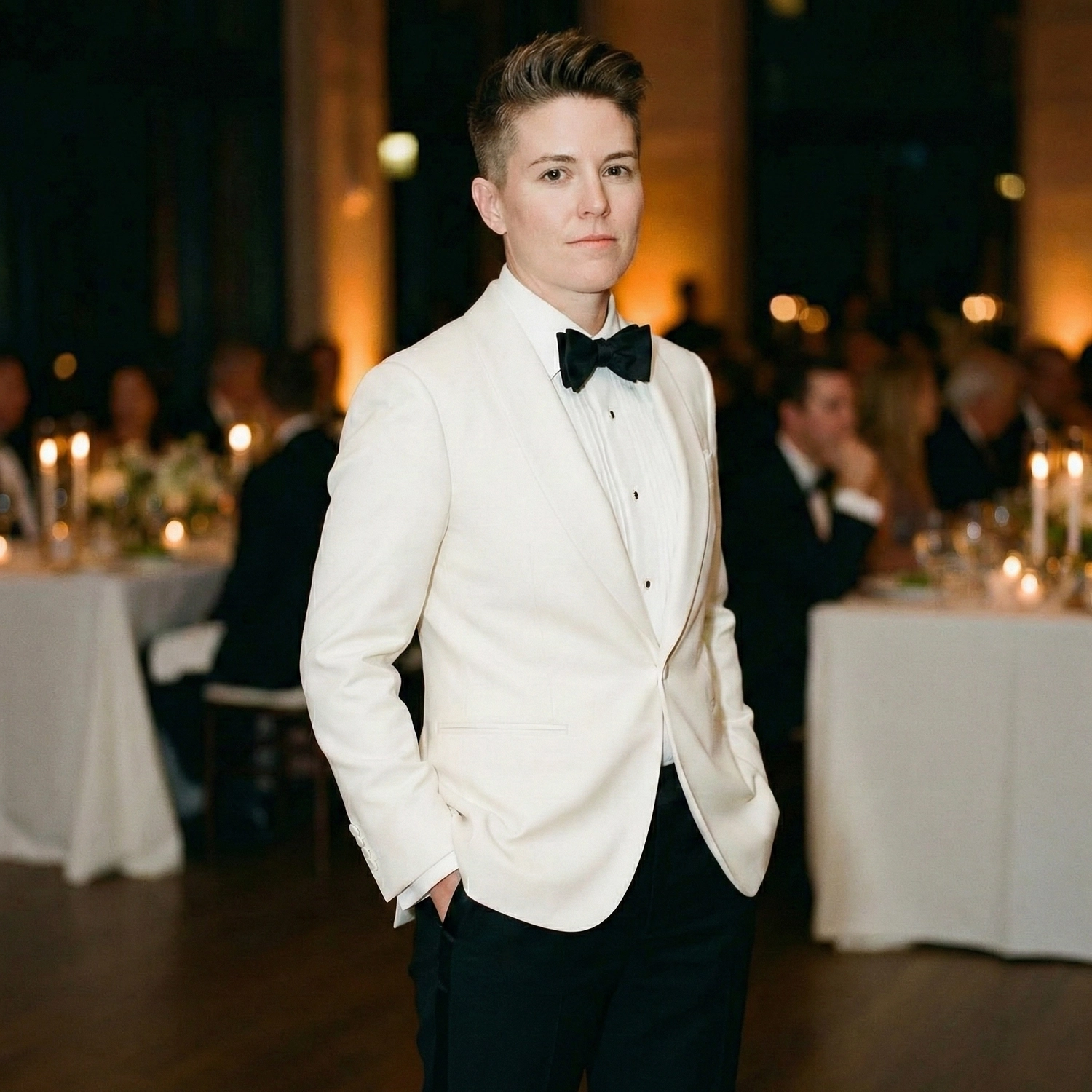
The centerpiece of this look is the Bespoke dinner jacket in Ivory. To execute this aesthetic with the gravity it deserves, strict adherence to technical protocols is required.
The Protocol: Contrast is Key
The most common misconception when exploring androgynous wedding suit colors is that an “Ivory Suit” implies an ivory jacket paired with matching trousers. In traditional tailoring, this is technically incorrect for a high-end Bespoke tuxedo look.
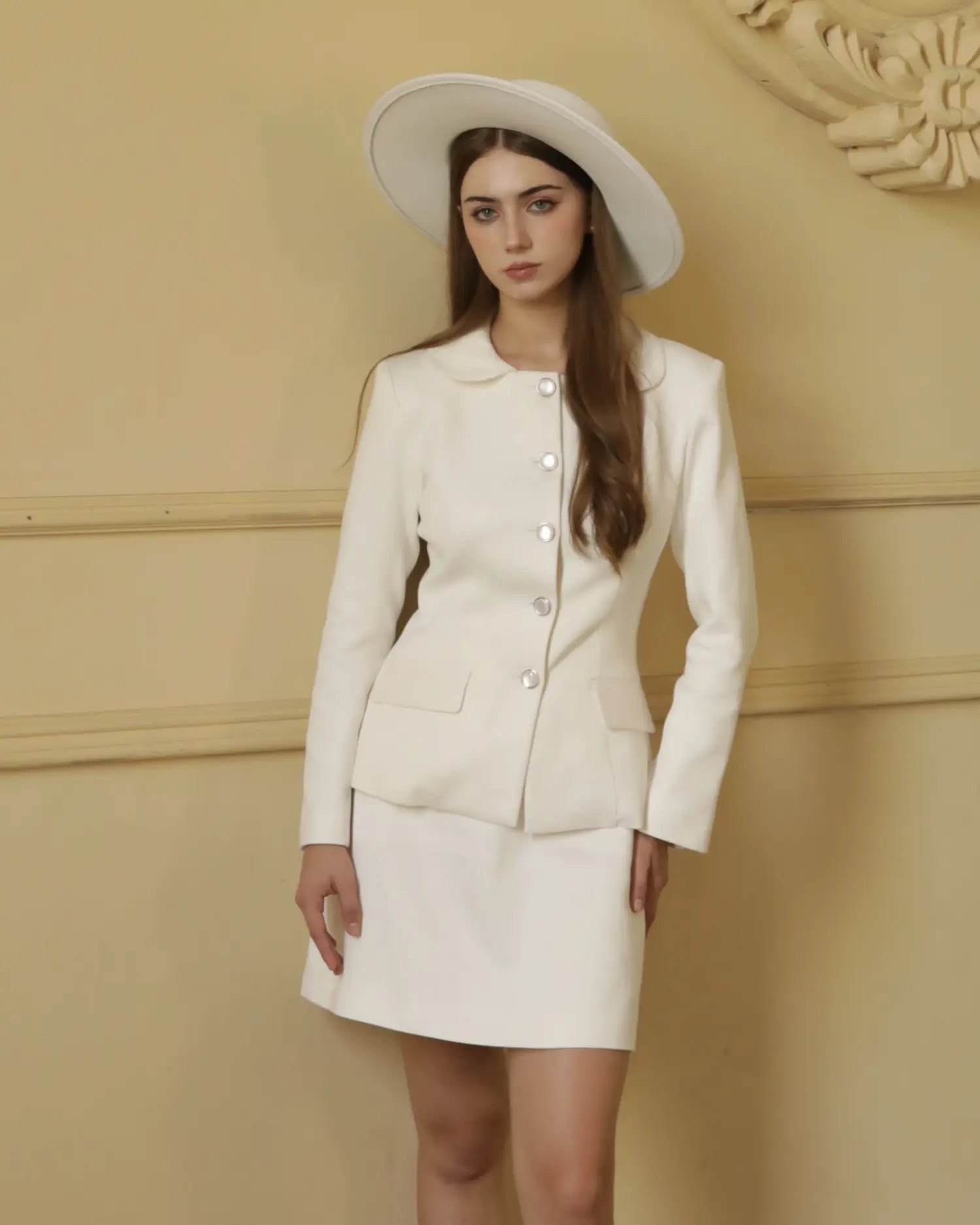
- The Jacket: A proper Bespoke dinner jacket utilizes a rich Ivory or Cream wool, rather than “Optic White.” Bright white reflects too much light, often causing the garment to look synthetic or “plastic” in flash photography. Ivory, conversely, offers a warm, luxurious tone that complements all complexions.
- The Lapels: Unlike a standard black tuxedo which uses contrasting satin lapels, an Ivory Dinner Jacket dictates the use of Self-Facing Lapels. This means the lapels are crafted from the same fabric and color as the body of the jacket, creating a seamless, uninterrupted visual line that elongates the torso.
- The Trousers: The jacket must be anchored by Black Tuxedo Trousers featuring a satin side stripe (galon). This high-contrast pairing serves a structural purpose: the black trousers “ground” the look, slimming the hips and legs, while the light jacket draws the eye upward to the face.
Fabrication: Pure Wool vs. The Rest
The choice of fabric dictates the architecture of the suit. While Bamboo or Linen blends are often suggested for their soft hand, they are generally ill-suited for a formal wedding.
- The Structure Issue: Bamboo and soft blends are “drapey” and tend to cling to the body. For an AFAB (Assigned Female at Birth) physique where the goal is often to obscure curves and create a masculine squareness, these fabrics fail to provide the necessary support.
- The Wool Advantage: The superior choice remains Pure Wool or high-twist Wool Blends. These fabrics possess a natural “crispness” and density. They act as a structural shell, hanging cleanly from the shoulder without collapsing into the waist or bust, ensuring the silhouette remains sharp from the ceremony to the final dance.
Jewel Tones: The Depth of Autumn & Winter Weddings
For weddings scheduled in the cooler months or evening receptions held under the warm glow of chandeliers, standard black can sometimes feel overly austere. This is where androgynous wedding suit colors like Jewel Tones, colors mimicking precious gemstones, come into play. These shades offer a powerful psychological effect: they convey regality, warmth, and a distinct sense of “occasion” without the loudness of bright primary colors.
The Palette: Beyond Black
Selecting the right hue is critical. The goal is to choose a shade that retains its dignity in low light while revealing its richness when photographed.
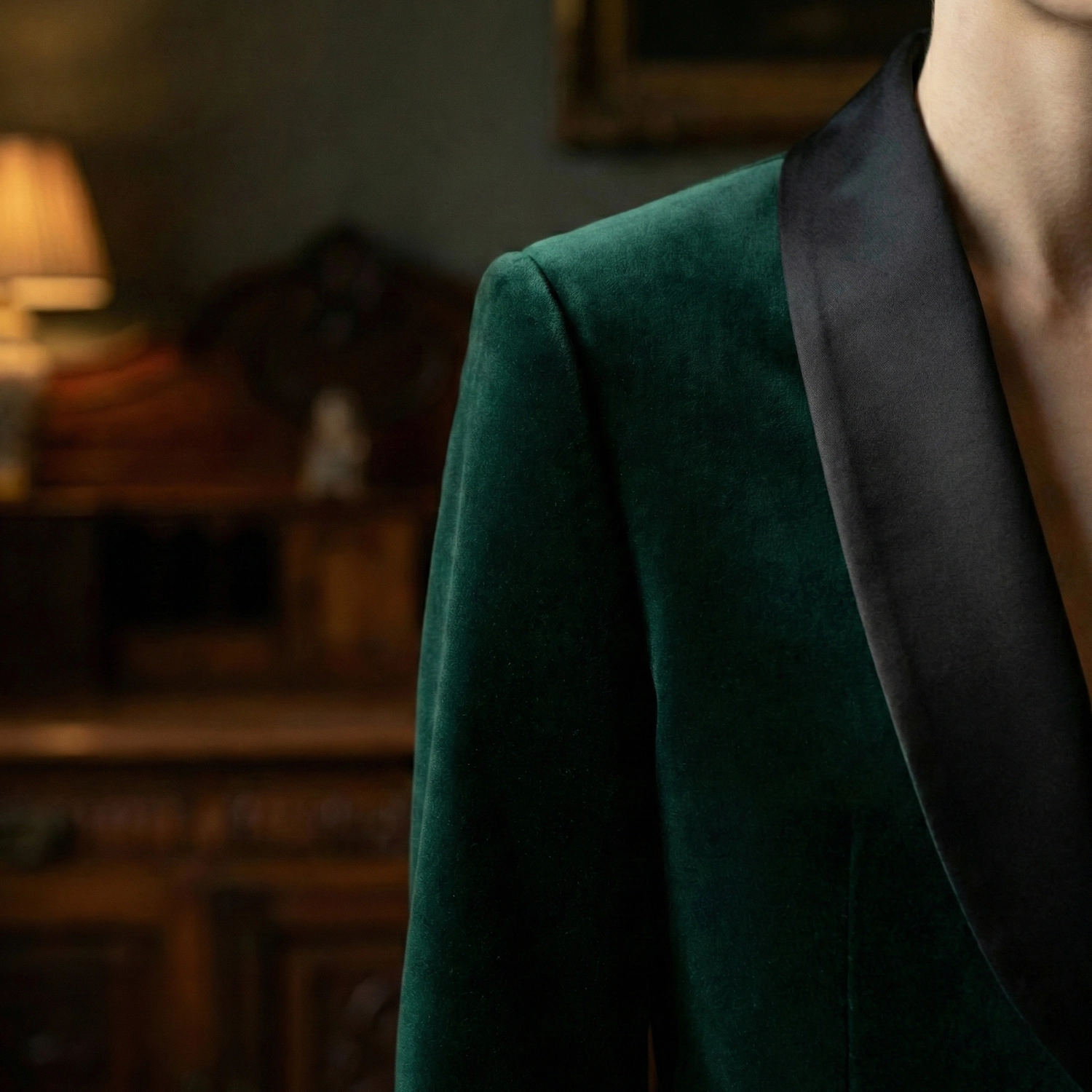
- Emerald Green & Deep Teal: A deep Emerald green tuxedo suit strikes a perfect balance between the traditional and the avant-garde. It symbolizes eternity and freshness, making it an excellent choice for rustic or garden weddings that transition into formal evening dinners. It pairs exceptionally well with gold accessories, creating a look of vintage opulence.
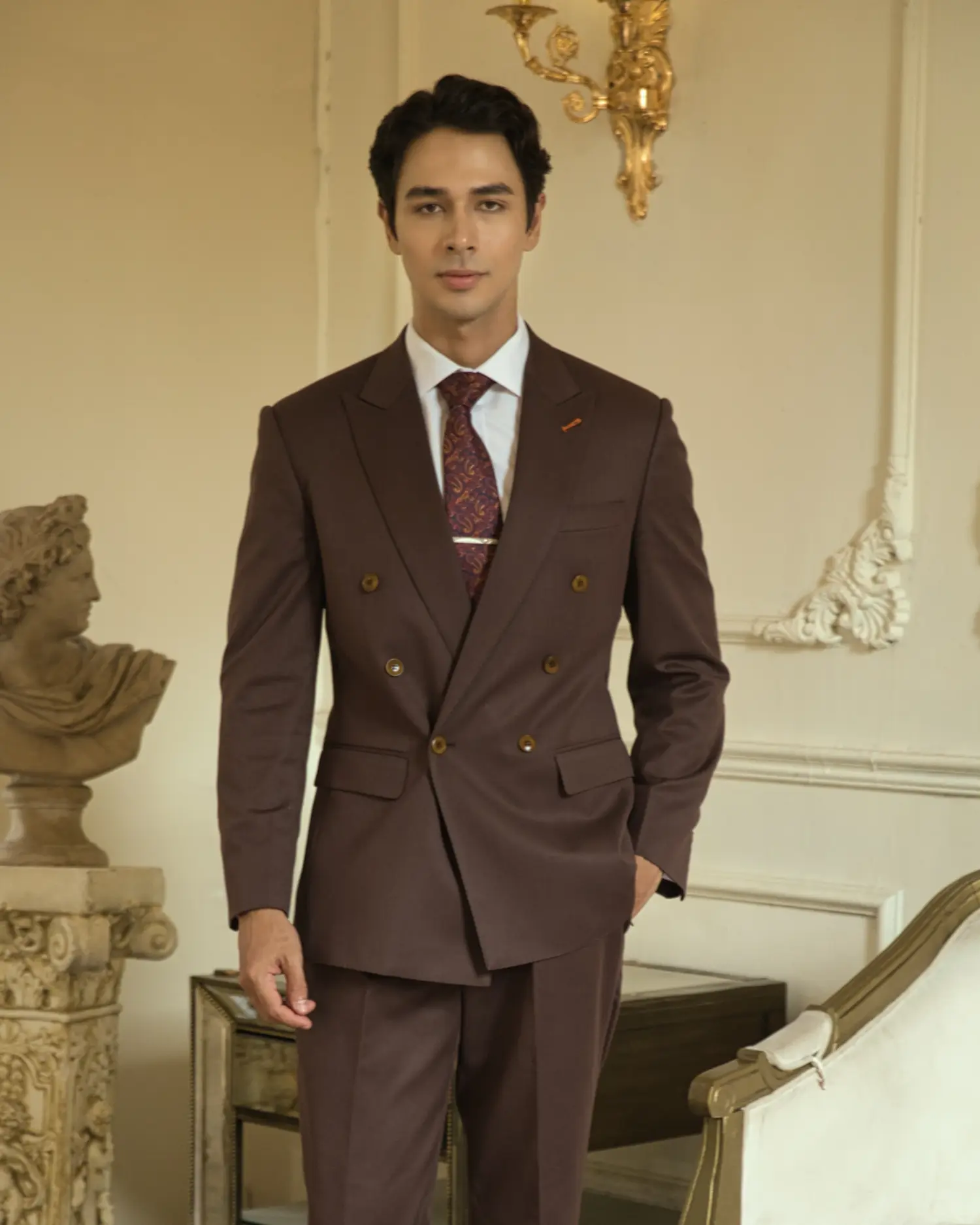
- Burgundy & Oxblood: As a direct alternative to the black tuxedo, a Burgundy dinner jacket offers unmatched romanticism. Unlike bright fire-engine red, which can be harsh, the deep purple-brown undertones of oxblood absorb light, providing a sophisticated warmth that flatters almost every skin tone.
- Midnight Blue: Often famously described as “blacker than black,” Midnight Blue creates a sharper contrast under artificial light than black itself. It is the safest entry point for those wishing to experiment with color while maintaining strict formal codes of a Bespoke tuxedo.
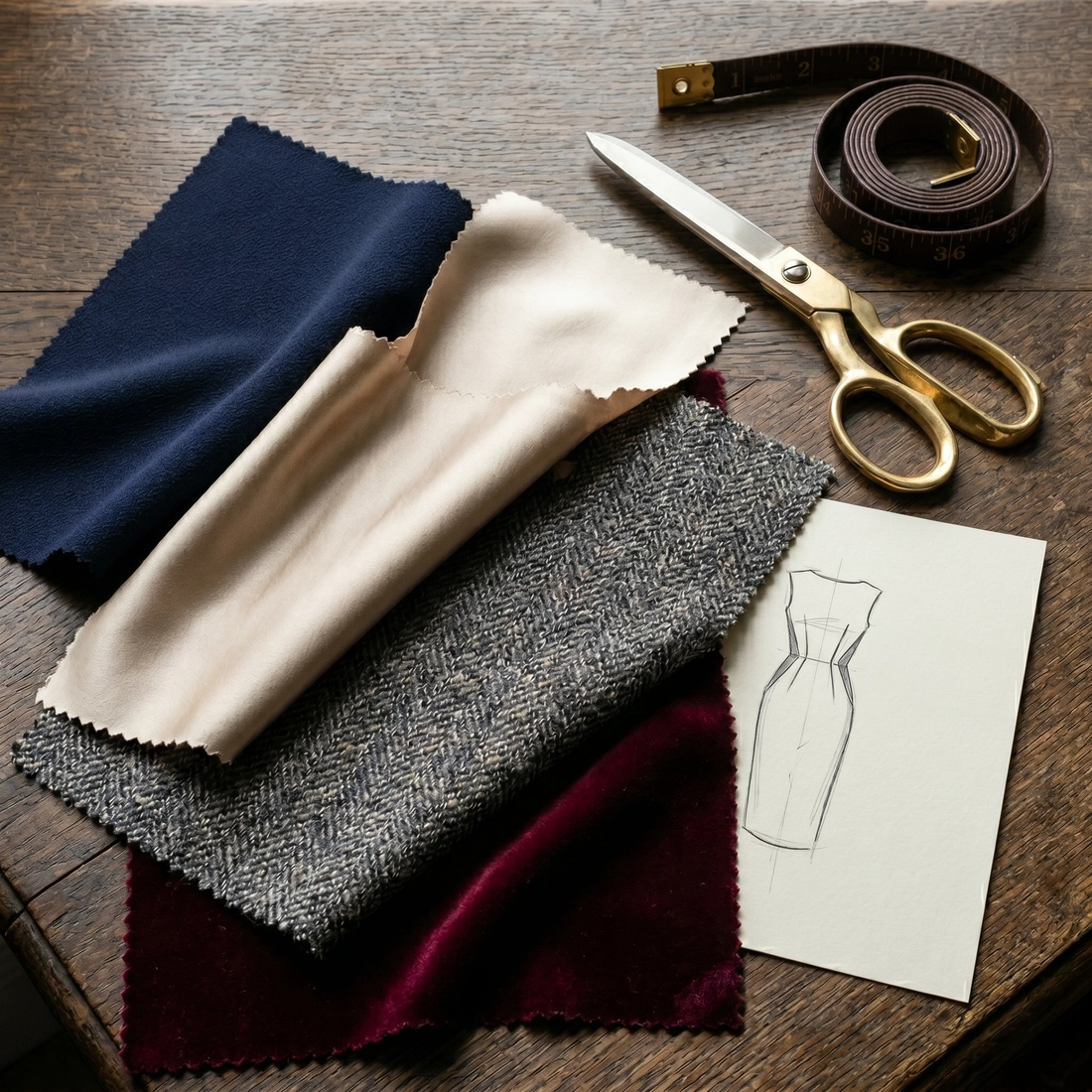
Material Science: Why Velvet Rules
Jewel tones can be executed in wool, but they reach their full potential when crafted in Velvet. The synergy between these deep colors and velvet fabric is rooted in physics.
Unlike wool or silk, which are woven flat, velvet has a “pile” – thousands of vertical fibers standing up.
- Depth of Color: This pile absorbs light rather than reflecting it. This absorption creates an optical illusion of immense depth, making an Emerald green tuxedo suit or burgundy piece look significantly richer and darker than it would on a flat weave.
- Structural Support: From a tailoring perspective, high-quality cotton or silk-blend velvet has a heavier weight (GSM). This natural heaviness allows the jacket to drape cleanly and vertically, providing excellent structural coverage that helps smooth out the silhouette, a key benefit for achieving a masculine line on an AFAB body.
Jacquards & Brocades: Texture as the Ultimate Luxury
For those who find solid colors too plain but prints too informal, the answer lies in texture. Jacquard and Brocade fabrics represent the pinnacle of textile artistry, offering a complexity that immediately distinguishes a wedding suit from business attire.
Defining the Weave
It is crucial to understand that a true Jacquard pattern is woven directly into the fabric’s structure, not printed upon the surface. This intricate weaving process creates a multi-dimensional effect where the pattern interacts with light, appearing subtle from a distance but revealing intricate detail up close. This depth is what separates a luxury Bespoke tuxedo from mass-produced novelty wear.
The Structural Advantage: Hiding the Curves
Beyond their visual appeal, Jacquard fabrics offer a significant functional benefit for androgynous tailoring. Due to the density of the weave, these fabrics typically possess a higher GSM (Grams per Square Meter) and a stiffer “hand” (feel) than standard wool.
This inherent rigidity serves as a powerful architectural tool:
- The “Armor” Effect: A heavy Jacquard jacket acts as a structural shell. Instead of draping softly and clinging to the body’s natural contours, the fabric holds its own shape.
- Straightening the Silhouette: This stiffness allows the tailor to construct a “boxier” profile. The fabric bridges the gap between the chest and waist, effectively obscuring the bust line and hip curve. For an AFAB physique seeking a masculine, straight-cut look, Jacquard is often the most effective material to engineer this illusion.
Styling Principle: Let the Fabric Speak
When wearing a textured jacket, the rule of styling is subtraction. The fabric itself is the statement.
- Pairing: A Jacquard dinner jacket should almost always be paired with solid black trousers to balance the visual weight.
- Accessories: Keep the shirt simple (a fly-front or minimal pleat) and avoid loud bow ties. The goal is to let the intricate weave of the jacket command attention without fighting for dominance.
Coordinating, Not Matching: Advice for Couples
A unique opportunity in LGBTQ+ weddings is the freedom for both partners to wear suits. However, this creates a specific styling challenge: how to create visual unity without looking like identical twins. Unless the dress code is strictly traditional Black Tie (where uniformity is the point), wearing identical colored suits should generally be avoided.
Instead of matching, the goal is coordination. The attire should converse, not echo.
The Power of Contrast (Light & Dark)
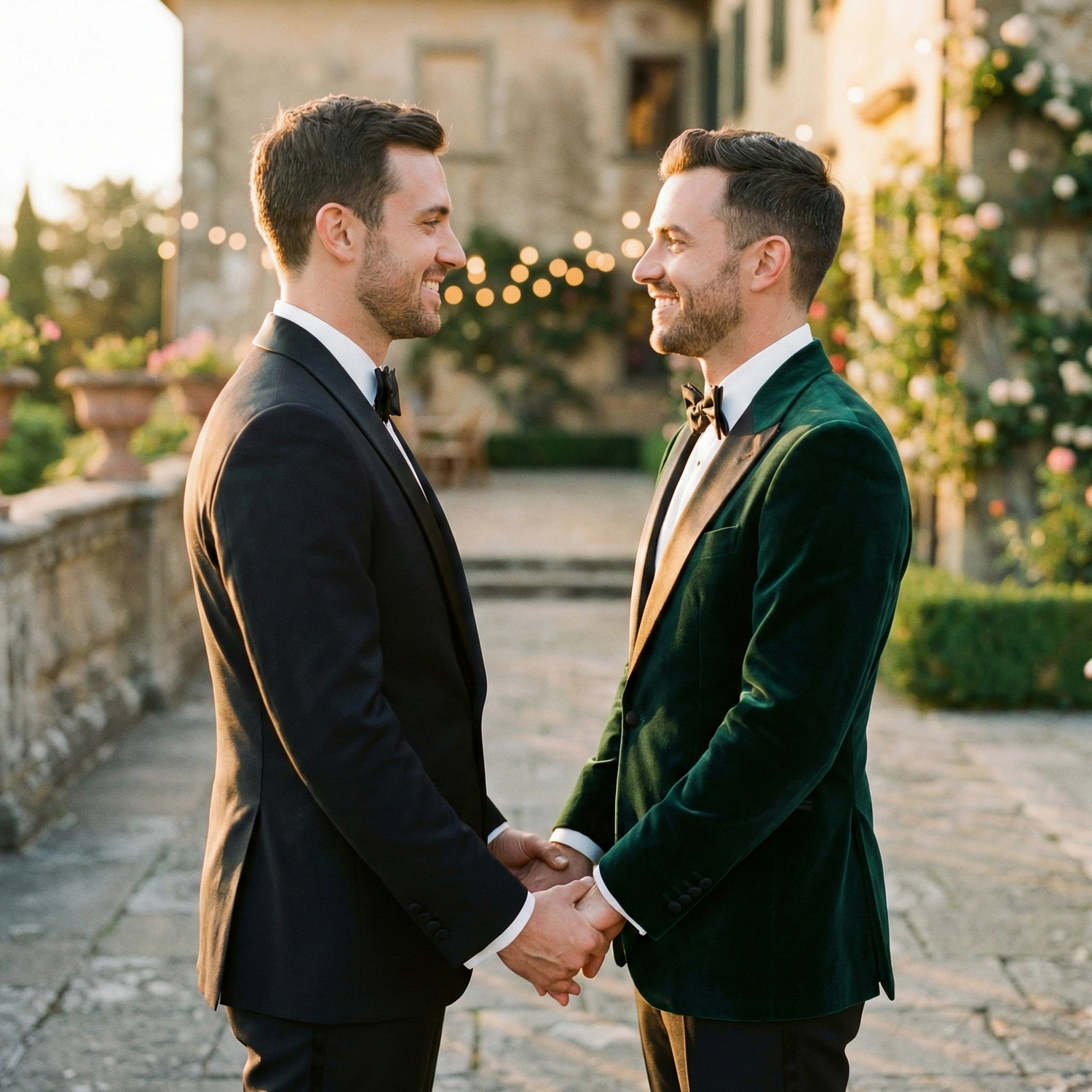
One of the most photogenic strategies is to utilize contrast. This involves one partner anchoring the look in a dark tone while the other opts for a lighter hue.
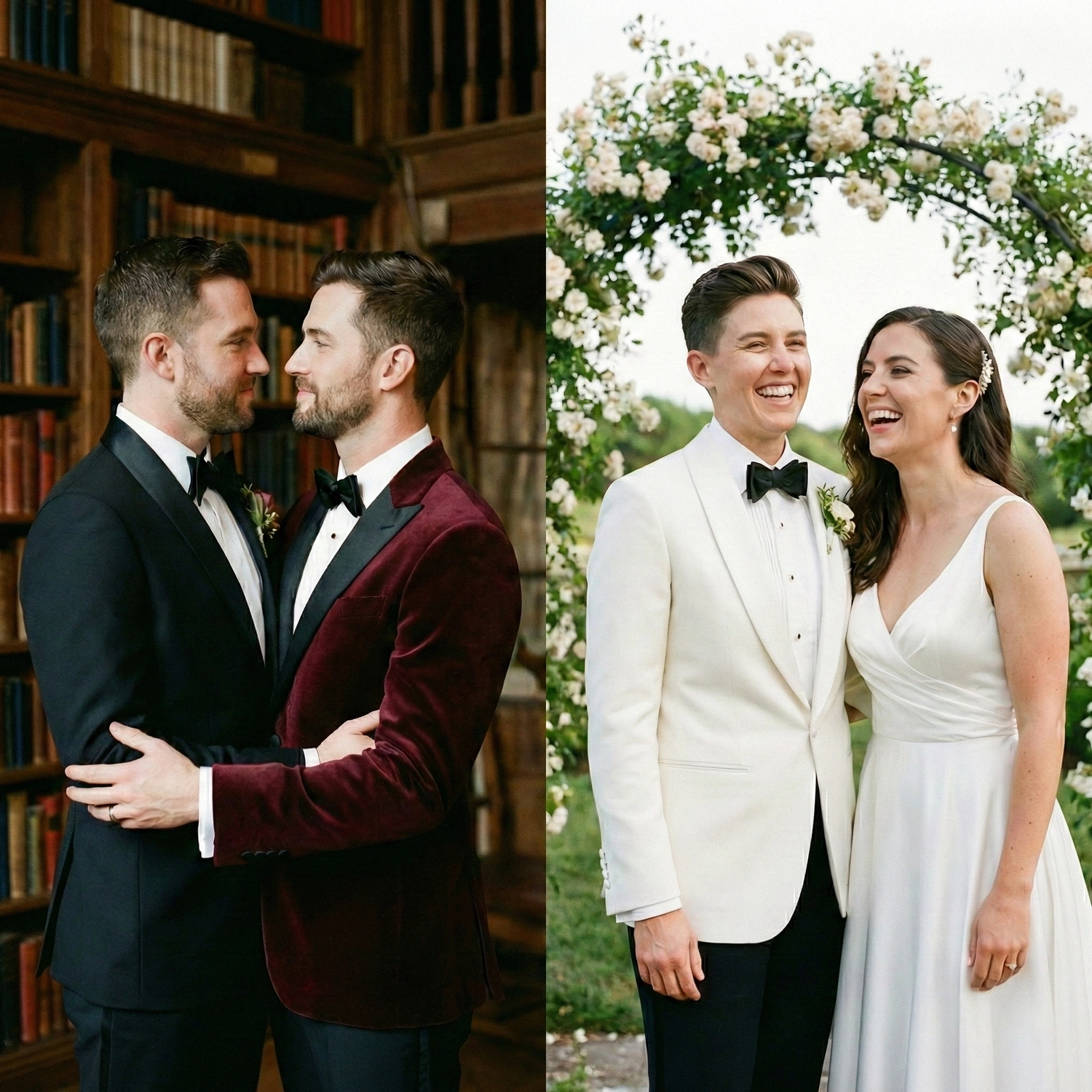
- The Combination: For example, one partner wears a Burgundy dinner jacket or Midnight Blue tuxedo, while the other dons an Ivory dinner jacket with black trousers.
- The Effect: This creates a balanced “Yin and Yang” visual. It separates the couple clearly in photographs so they do not blend into a single block of color, allowing each individual to shine while looking undeniably cohesive.
Texture vs. Tone (Monochromatic Depth)
If both partners desire the same color palette – for instance, a shared love for deep green – the differentiation must come from texture rather than hue.
- The Strategy: Partner A might choose a matte fabric, such as a sharp Barathea wool suit. Partner B, to complement this, should select a light-absorbing fabric like Velvet or a light-reflecting Jacquard in the same shade.
- The Result: Although the color is identical, the difference in how the fabrics interact with light creates necessary visual separation and depth.
The Unifying Thread
To tie two distinct looks together, subtle details serve as the bridge. This can be achieved through accessories rather than the main garments. A pocket square, a boutonniere, or even the inner lining of the jackets can share a common color thread, signaling unity in a discreet, sophisticated manner.
Conclusion
Breaking away from the standard black tuxedo allows you to tell a richer story. Whether you are drawn to the crisp modernity of Ivory, the regal warmth of Jewel Tones, or the structured luxury of Jacquard, these choices empower you to stand out authentically.
However, a bold aesthetic relies heavily on a flawless silhouette. Now that you have defined your palette, ensure the architecture of your Bespoke tuxedo is equally precise by revisiting our essential guide: [Beyond the Gown: The Definitive Guide to LGBT & Androgynous Bridal Suits].
DISCOVER PHYIGITAL BESPOKE TAILORING